Bildnis Madame Trabuc
Vincent van Gogh · 1889
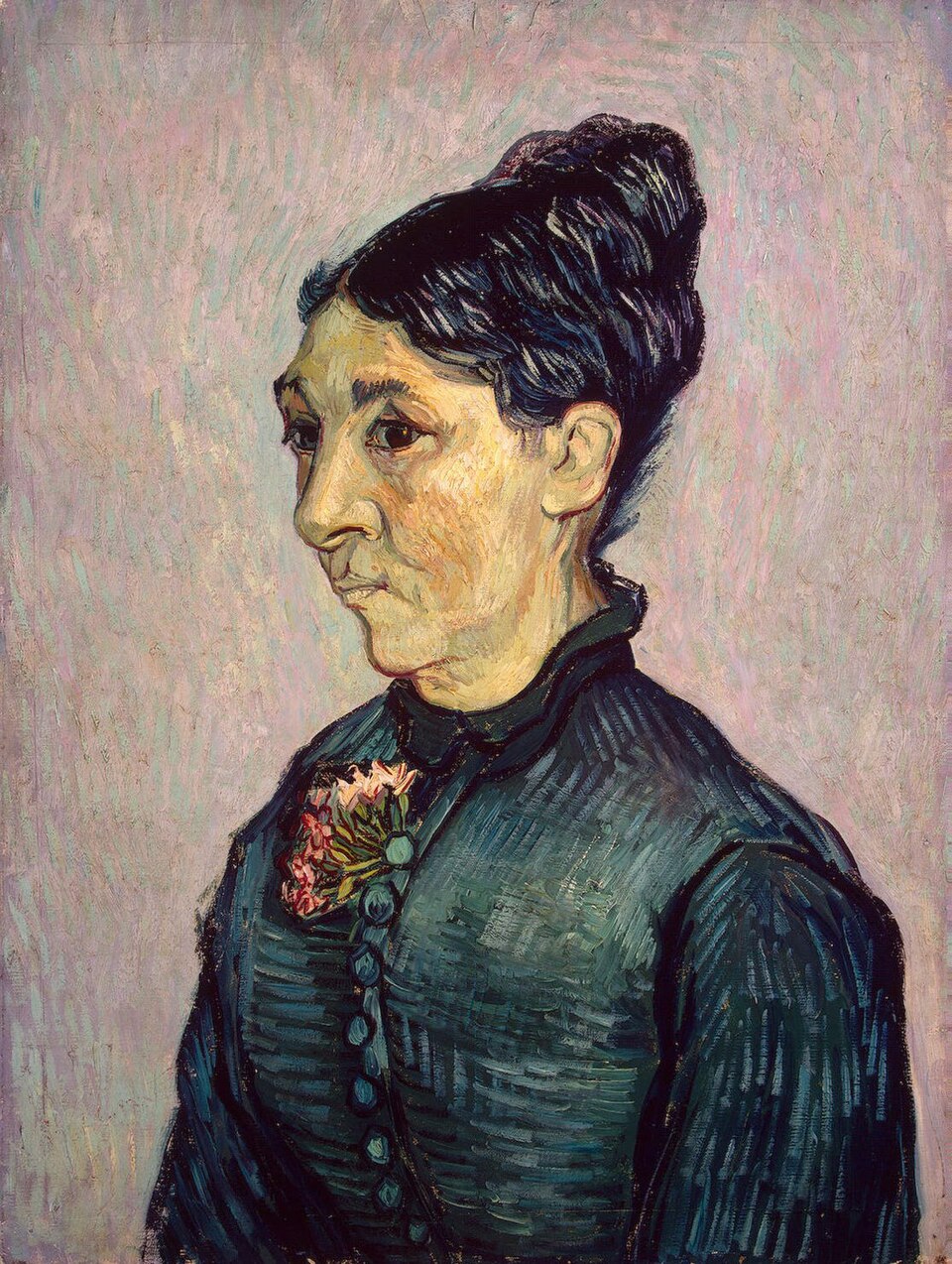
At the asylum of Saint-Rémy, Van Gogh painted the wife of the chief attendant. He found her gentle and unhappy, and painted her in black and pink.
The story behind the painting
Around 6 September 1889, Van Gogh wrote to his brother Theo that he urgently needed to work at his painting and feared another attack of madness. He said he had painted Trabuc, the attendant at the asylum, and was about to paint his wife. He found her gentle and unhappy. The Trabuc couple lived in a small house a few steps from the Saint-Paul asylum at Saint-Rémy-de-Provence. On 19 September he wrote again that the portrait of Madame Trabuc was finished.
What to look for
In that letter Van Gogh described the picture as done in tones of black and pink, and to his sister Willemina he wrote of a portrait of a woman dressed in black with an olive complexion. Look for that contrast between the dark dress and the skin. He also said he had made a copy, less successful than the original. Jeanne Trabuc, born Lafuis, was fifty-five when she posed. She was a woman of the people.
Meaning and intent
According to Pickvance, Madame Trabuc resembles the peasant figures in English prints of the 1870s that Van Gogh loved to collect, especially those from the weekly The Graphic. The portrait shows how, in a period of fear about his own health, Van Gogh turned to the people closest to him at the asylum and looked at them with sympathy. He thought Theo would like this painting, and his description of her as gentle and unhappy is the heart of the work.
Legacy
The portrait belonged to Johanna van Gogh, then was sold to the Thannhauser gallery in Berlin, where Otto Krebs acquired it. Like the rest of that collection, it was taken by the Red Army to the Hermitage in 1947 as reparation for war damage. It was shown to the Hermitage public for the first time in 1995, in an exhibition of French nineteenth and twentieth century painting from private collections in Germany. It remains in the Hermitage Museum in Saint Petersburg.
Schon gewusst?
- Painted in September 1889 at Saint-Rémy-de-Provence.
- The sitter, Jeanne Trabuc, was 55.
- Van Gogh described it as black and pink tones.
- First shown publicly at the Hermitage in 1995.
Über den Künstler
Vincent van Gogh (1853-1890)
Frau · Porträt · Eremitage · Sammlung Otto Krebs
Mehr von Vincent van Gogh
 Die Sternennacht - Vincent van Gogh (1889)
 Caféterrasse am Abend - Vincent van Gogh (1888)
 Sonnenblumen - Vincent van Gogh (1888)
 Mandelblüte - Vincent van Gogh (1890)
 Weizenfeld mit Raben - Vincent van Gogh (1890)
 Das Schlafzimmer - Vincent van Gogh (1888)
 Die Kartoffelesser - Vincent van Gogh (1885)
 Schwertlilien - Vincent van Gogh (1889)
Werke verwandter Künstler
 Die großen Badenden - Paul Cézanne (1900s)
 Der Knabe mit der roten Weste - Paul Cézanne
 Woher kommen wir? Wer sind wir? Wohin gehen wir? - Paul Gauguin (1897-1898)
 Der gelbe Christus - Paul Gauguin (1889)
 Die Aufrichtung des Kreuzes - Peter Paul Rubens (1609)
 Der Raub der Töchter des Leukippos - Peter Paul Rubens (1618)
 Strandspaziergang - Joaquín Sorolla (1909)
 Sad Inheritance - Joaquín Sorolla (1898)
 Tanz im Moulin de la Galette - Pierre-Auguste Renoir (1876)
 Das Frühstück der Ruderer - Pierre-Auguste Renoir (1881)
 Das Promenoir des »Moulin Rouge« - Henri de Toulouse-Lautrec (1892)
 Die Toilette - Henri de Toulouse-Lautrec (1896)