Pastoral Pleasure
Antoine Watteau · 1714
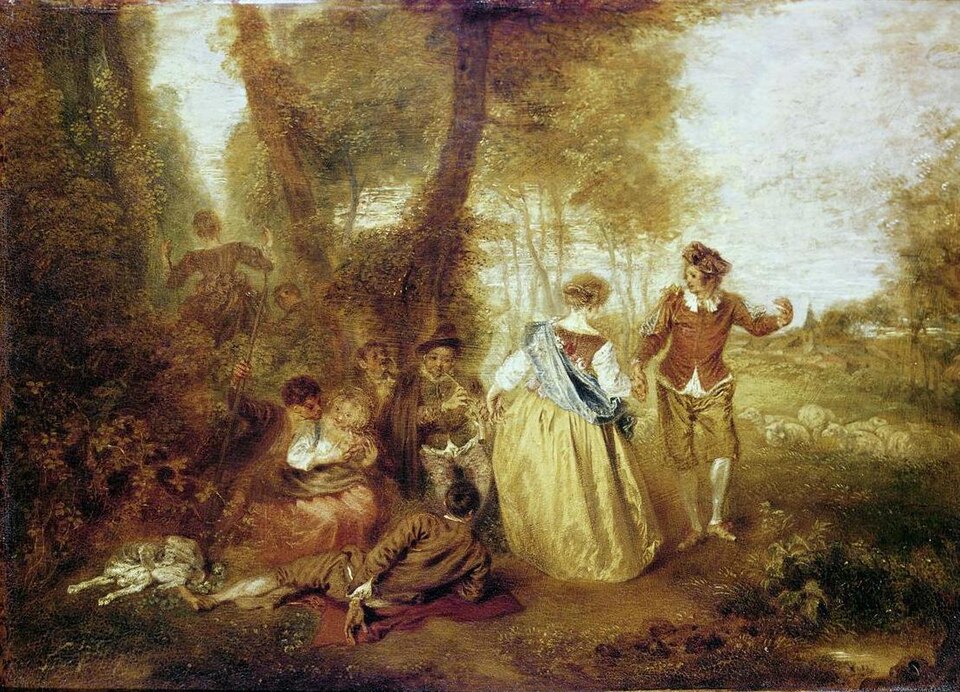
French aristocrats dressed as shepherds dance and flirt in the open air, while real peasants stand among them in plainer clothes. Pastoral Pleasure is a small Watteau canvas that may be the first idea for one of his best known scenes.
The story behind the painting
Le Plaisir pastoral is a fete galante painted by Antoine Watteau around 1714 to 1716; Wikidata gives 1714. Two other Watteau paintings survive with extremely similar compositions. The largest and most finished is The Shepherds, now in Charlottenburg Palace in Berlin, and another, once owned by Georges Wildenstein, seems to be a reworking of the Berlin picture. The art historian Pierre Rosenberg argues that this Chantilly canvas was an oil sketch for the one in Berlin.
What to look for
The picture is small, about 31 by 44 cm. On the right one couple dances; on the left a young couple courts on a balcony. Look for the difference in clothes and gestures: real peasants appear in simpler dress and with simpler movements, so here it is easier than in The Shepherds to tell them apart from the aristocrats in costume. Several details come straight from paintings by Peter Paul Rubens: the musician, the man beside him, the shepherd embracing the woman next to him, and the dog in the foreground.
Meaning and intent
The scene is a game of dressing up. Wealthy people play at country life, and Watteau places them right beside the people whose life they are borrowing. Because the real villagers are so clearly marked out here, the painting lets us see the gap between the costume and the life it imitates, a gap that the finished Berlin version blurs more softly. Under the music and the dancing there is a quiet question about pretending.
Legacy
The painting belonged to Pierre-Jean Mariette, a great Watteau collector, from at least 1729, around the time Nicolas-Henri Tardieu made an engraving after it. It was sold after Mariette's death on 1 February 1775 and, according to Edmond de Goncourt, sold again in Paris on 11 May 1789, entering the collection of the marquis de Maison. The duc d'Aumale bought that whole collection in 1868 while in exile in England, and on his return hung the work at the chateau de Chantilly, where it still hangs in the Musee Conde.
Schon gewusst?
- Painted around 1714-1716; Wikidata gives 1714.
- Pierre Rosenberg sees it as an oil sketch for The Shepherds in Berlin.
- Owned by Pierre-Jean Mariette from at least 1729.
- In the Musee Conde at Chantilly.
Über den Künstler
Antoine Watteau (1684-1721)
Frau · Laubbaum · Musée Condé · Fête galante · Tanz · Courtoisie
Mehr von Antoine Watteau
 Einschiffung nach Kythera - Jean-Antoine Watteau (1717)
 Gilles - Jean-Antoine Watteau (1718)
 Das Ladenschild des Kunsthändlers Gersaint - Jean-Antoine Watteau (1720)
 Der Gleichgültige - Jean-Antoine Watteau (1710s)
 Venezianische Feste - Jean-Antoine Watteau (1719)
 Jupiter und Antiope - Jean-Antoine Watteau (1716)
 Actors of the Comedie-Francaise - Jean-Antoine Watteau (1710s)
 Mezzetin - Jean-Antoine Watteau (1717)
Werke verwandter Künstler
 Die Erschießung der Aufständischen - Francisco Goya (1814)
.jpg) Die nackte Maja - Francisco Goya (1800)
Die nackte Maja - Francisco Goya (1800)