Nächtliche Landschaft mit der Ruhe auf der Flucht
Rembrandt van Rijn · 1647
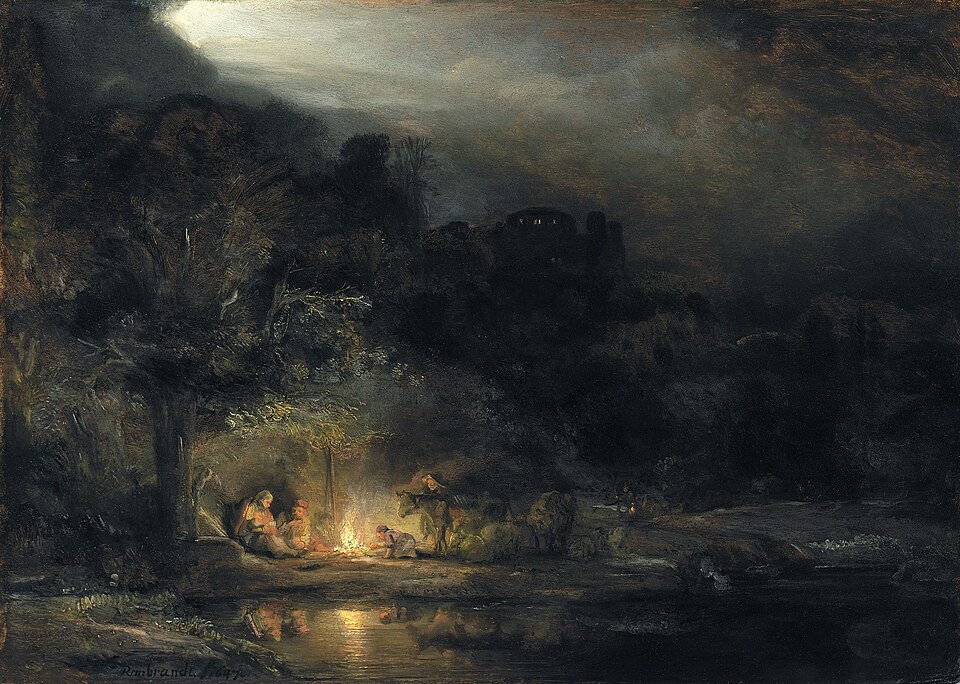
A small campfire burns under a tree in the dark, and around it sit Mary, Joseph and the Child among shepherds and cattle. It is the only night scene among Rembrandt's seven or eight painted landscapes, and for a long time nobody was sure what it showed.
The story behind the painting
Rembrandt painted this small oil on mahogany panel in 1647 and signed it at lower left, Rembrandt. f. 1647. He took his idea from The Flight into Egypt by the German painter Adam Elsheimer, painted in 1609 and now in the Alte Pinakothek in Munich. Rembrandt kept the general theme of the older picture, but he tried to surpass his predecessor. Unlike Elsheimer, and unlike the painting habits of his own time, he made the Holy Family a simple staffage, small figures set inside a landscape that becomes the true subject of the work.
What to look for
The campfire is the main source of light. It catches the figures and the tree above them in warm reds, greens, violets and yellows, while the rest of the scene falls into near darkness. In the middle distance another figure approaches holding a lantern, a small warm point in the cold moonlight. The moon lights a cloudy sky, against which stands a domed building with lit windows that may be the Temple of Jerusalem. In the lake in front, the figures are reflected, painted slightly darker than the figures themselves, which makes the reflections look true.
Meaning and intent
The Holy Family sits off centre and small, beside shepherds with oxen and sheep, a placement that stresses their humility. Rembrandt layered three lights: the strong fire in front, the weaker lantern behind, and the diffuse moon far away. Because brighter lights seem to come forward, this gradation builds depth in the landscape. His darker reflections anticipate a rule that Gérard de Lairesse only set down half a century later, in his Great Book of Painters of 1707. Even the subject is debated: the scene lacks the traditional donkey, and the art historian Jan Kelch suggested it might show the Adoration of the Shepherds.
Legacy
For a long time critics read the picture simply as a landscape, as Horace Walpole did in 1762, or as a gypsy camp, as G. F. Waagen did in 1854. In 1811 the painter J. M. W. Turner identified it as the Flight into Egypt, but that reading only spread after Wilhelm von Bode's catalogue of 1883. The painting is recorded in 1752 in the collection of the English banker Henry Hoare II at Stourhead. It passed to his descendants, who sold it to the National Gallery of Ireland in Dublin in 1883, where it remains.
Schon gewusst?
- Oil on mahogany panel, signed and dated 1647, about 34 x 48 cm.
- The only night scene among Rembrandt's seven or eight painted landscapes.
- Inspired by Adam Elsheimer's Flight into Egypt of 1609.
- In the National Gallery of Ireland since 1883.
Über den Künstler
Rembrandt van Rijn (1606-1669)
religiöse Kunst · National Gallery of Ireland · historical landscape
Mehr von Rembrandt van Rijn
 Die Nachtwache - Rembrandt van Rijn (1642)
 Selbstbildnis - Rembrandt van Rijn (1659)
 Die Anatomie des Dr. Tulp - Rembrandt van Rijn (1632)
 Die Judenbraut - Rembrandt van Rijn (1660s)
 Der Sturm auf dem See Genesareth - Rembrandt van Rijn (1633)
 Die Rückkehr des verlorenen Sohnes - Rembrandt van Rijn (1668)
 Danaë - Rembrandt van Rijn (1636)
 Das Gastmahl des Belsazar - Rembrandt van Rijn (1636)
Werke verwandter Künstler
 Das Mädchen mit dem Perlenohrgehänge - Johannes Vermeer (1665)
 Dienstmagd mit Milchkrug - Johannes Vermeer (c. 1658)
 Fest des hl.Nikolaus - Jan Steen (1660s)
 Mädchen mit Austern. - Jan Steen (1658)
 Ein Schütze einen Berkemeyer haltend, bekannt als „Der fröhliche Trinker" - Frans Hals (1620s)
 Der lachende Kavalier - Frans Hals (1624)
 Die Mühle von Wijk - Jacob van Ruisdael (1670)
 Judenfriedhof - Jacob van Ruisdael (1650s)
 Hof eines Hauses in Delft - Pieter de Hooch (1658)
 A Woman Peeling Apples - Pieter de Hooch (1663)