Gemäldezyklus »Mariage à la Mode«, Szene: Besuch beim Kurpfuscher
William Hogarth · 1743
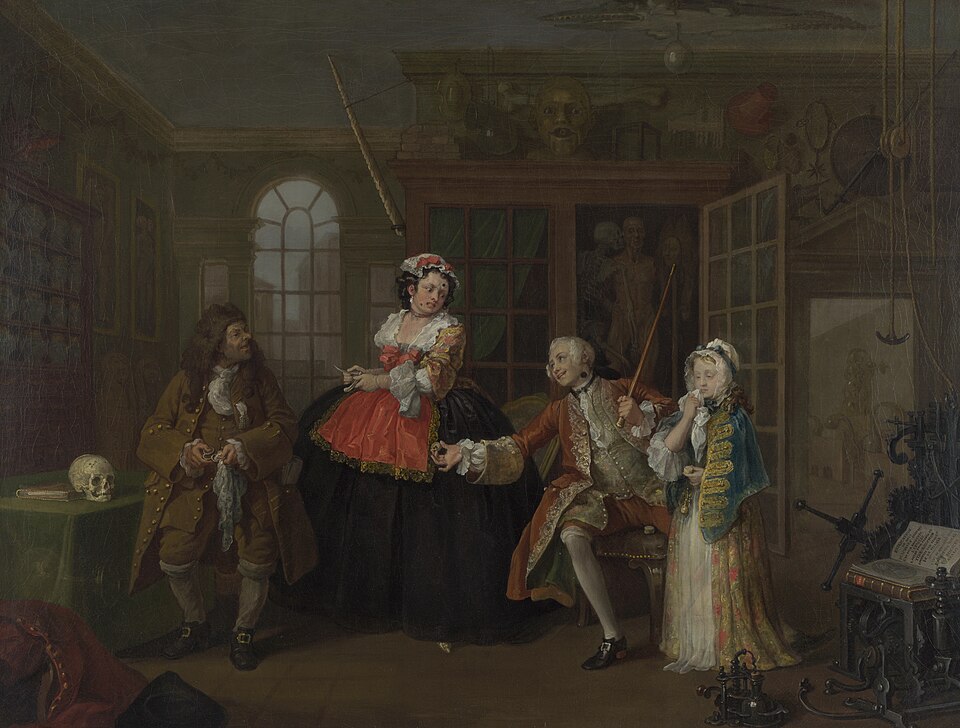
A young viscount brings a girl to a quack doctor's crowded room, among skeletons, pill boxes and a stuffed crocodile. In the third scene of Hogarth's marriage story, critics still disagree about who is deceiving whom.
The story behind the painting
The Inspection is the third canvas in Hogarth's series of six satirical paintings, Marriage A-la-Mode. The Viscount, suffering from syphilis, visits a French doctor. The black patch on his neck, already present in the earlier scenes, is Hogarth's sign of the disease. The doctor is based on Dr Rock, who also appears in A Harlot's Progress and whose surgery was at 96 St Martin's Lane, Westminster. With the Viscount are a child and a taller woman who is opening a clasp knife and turning away from him, clearly disliking him.
What to look for
The room is crammed. A cabinet on the left holds apothecary's pots, with a wolf's head on top, and on the wall hang pictures of monsters. A half-open cabinet at the back reveals a skeleton leaning against an embalmed body, beside a long wig on a plaster head. Along the wall run a narwhal tusk, pill boxes, a bleeding basin, a glass urinal, a giant plaster head with a femur, a tripod or gallows tree, a tall red hat, two mismatched shoes, a spur, a buckler and a sword. A stuffed crocodile hangs from the ceiling with an ostrich egg. On the right stand absurd machines, described in an open book as for setting shoulders and pulling corks.
Meaning and intent
Commentators disagree about the woman with the knife: the child's mother, the doctor's assistant or another prostitute. One view says Hogarth would have placed a mother next to her child. Judy Egerton, curator of the National Gallery's exhibition, read it very differently: the Viscount believes he has infected the girl; her mother feigns anger to blackmail him; and the girl already had the disease, either from earlier protectors or inherited from her father, the quack himself. The book's inscription, inspected and approved by the Royal Academy at Paris, is Hogarth mocking French medicine.
Legacy
The commentator Georg Christoph Lichtenberg read the basin, urinal, tripod, hat and spurs as the doctor's whole career: barber, quack, near execution, doctor and finally knighthood. The painting, about 69.9 by 90.8 cm, hangs with the rest of the series in the National Gallery, London; Wikidata dates it 1743. Seen in sequence, it is the moment where the comedy of fashion turns into disease and deceit, three scenes into a story of six.
Schon gewusst?
- Third of the six paintings of Marriage A-la-Mode.
- The doctor is based on Dr Rock of St Martin's Lane.
- The woman with the knife has several disputed identities.
- In the National Gallery, London.
Über den Künstler
William Hogarth (1697-1764)
Mehr von William Hogarth
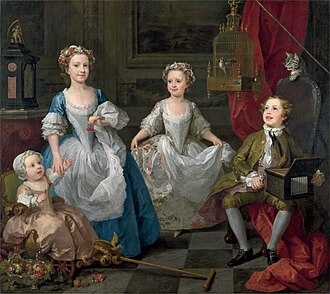 Porträt der Graham-Kinder - William Hogarth (1742)
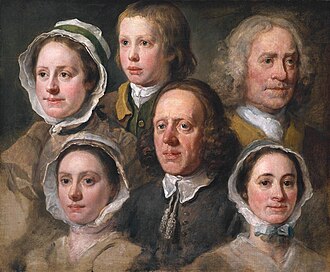 Hogarth's Servants - William Hogarth (1750s)
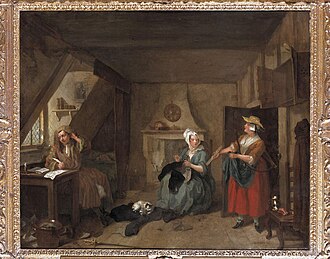 Der gepeinigte Poet - William Hogarth (1730s)
 Gemäldezyklus »Mariage à la Mode«, Szene: Kurz nach der Hochzeit - William Hogarth (1743)
 David Garrick as Richard III - William Hogarth (1745)
 Gemäldefolge »Der Lebensweg eines Wüstlings«, Szene: Szene in einer Schenke - William Hogarth (1735)
 Gemäldezyklus «Mariage à la Mode», Szene (6): Selbstmord der Comtesse - William Hogarth (1743)
Der letzte Widerstand - William Hogarth (1759)