Gemäldezyklus »Mariage à la Mode«, Szene: Der Ehevertrag
William Hogarth · 1743
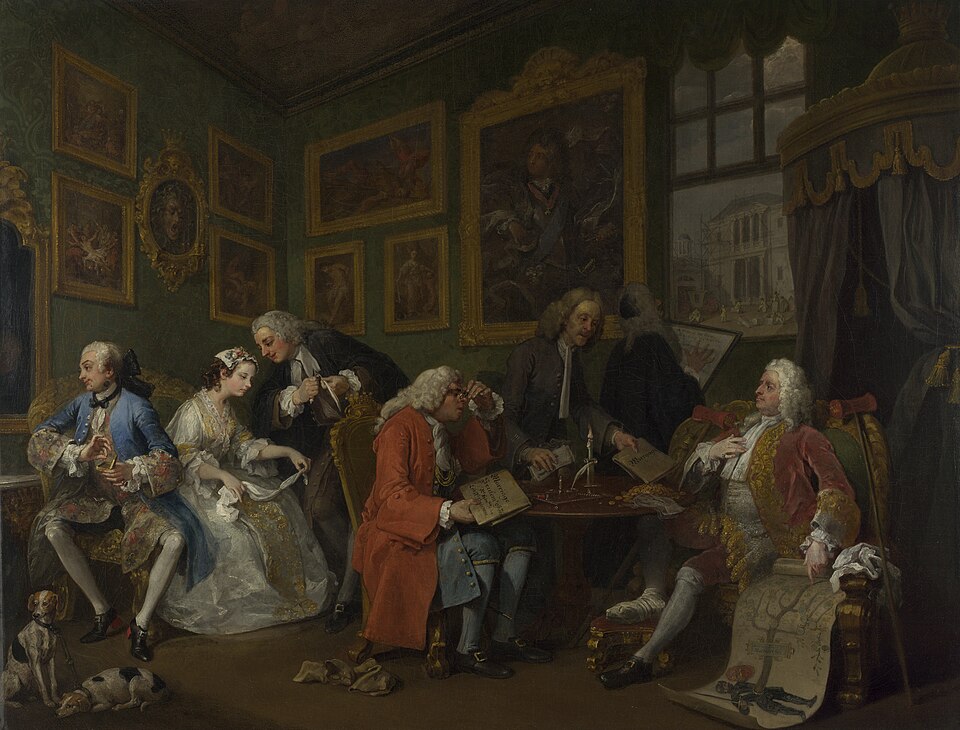
Two fathers count money and contracts while their children sit back to back, bored and already lost to each other. Hogarth opens his story of a fashionable marriage with a deal, and fills every wall of the room with warnings.
The story behind the painting
This is the first of the six satirical paintings Hogarth called Marriage A-la-Mode, named after the legal arrangement of a marriage settlement. All the main characters appear here. Earl Squanderfield, heavily in debt but proud of his ancient title, sits under a canopy. Facing him is the Alderman, a rich merchant who wants a noble grandson. The Earl wants his line continued and will tolerate a commoner for his money. Their children, the Viscount and the Alderman's daughter, ignore each other, while the lawyer Silvertongue, named only in the final scene, is already courting the bride.
What to look for
The Earl rests a bandaged, gouty foot on a stool and points proudly to his family tree, which begins with William the Conqueror; a broken branch hints at a disowned marriage. Coronets are everywhere. On the table lie gold and bills of exchange, the bride's dowry, while the Alderman peers at the contract and a threadbare clerk hands back mortgage papers. Through the window rises the Earl's costly unfinished house in a muddled neo-Palladian style, watched by a man holding plans. On the left, the Viscount admires himself in a mirror, dressed in the French style, with a black patch on his neck; the bride fidgets with her ring as Silvertongue whispers to her.
Meaning and intent
Hogarth's target is the greed of the two fathers. The forced, loveless match is mirrored by a dog and a bitch chained together and ignoring each other. The Viscount's mirror is cut in half by the edge of the canvas, marking him as only half a man, and his neck patch is a sign of syphilis. The paintings on the walls show martyrdoms and disasters: St Agnes, St Lawrence, the Massacre of the Innocents, Cain and Abel, Judith and Holofernes, and a screaming Gorgon above the couple. A portrait shows the Earl as a young Jupiter, god of oaths, looking away from the oath being made.
Legacy
The opening scene sets up the whole series, including details that pay off later: Silvertongue's name is revealed only in the sixth plate, and in Hogarth's engraving of this scene the reflection in the Viscount's mirror is clearly Silvertongue's. The commentator Georg Christoph Lichtenberg read the ceiling painting, the Red Sea closing over Pharaoh's armies, as a symbol of the Earl's lack of logic in starting a new house without knowing whether he could afford it. The painting is in the National Gallery, London; Wikidata dates it 1743 and records 70 by 91 cm.
Schon gewusst?
- First of the six paintings of Marriage A-la-Mode.
- Shows a marriage contract between an Earl's son and a merchant's daughter.
- Full of satirical paintings within the painting.
- In the National Gallery, London.
Über den Künstler
William Hogarth (1697-1764)
Genreszene · National Gallery · Familie
Mehr von William Hogarth
 Porträt der Graham-Kinder - William Hogarth (1742)
 Hogarth's Servants - William Hogarth (1750s)
 Der gepeinigte Poet - William Hogarth (1730s)
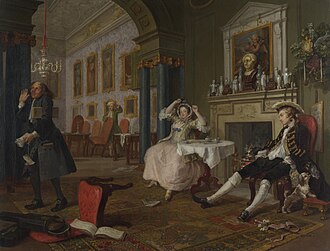 Gemäldezyklus »Mariage à la Mode«, Szene: Kurz nach der Hochzeit - William Hogarth (1743)
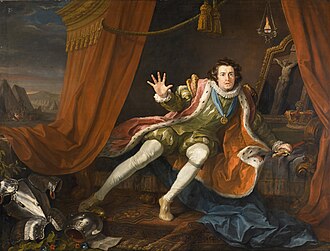 David Garrick as Richard III - William Hogarth (1745)
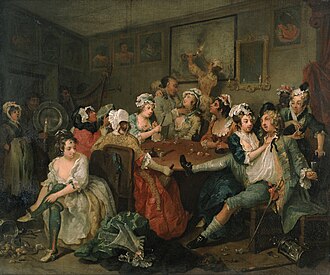 Gemäldefolge »Der Lebensweg eines Wüstlings«, Szene: Szene in einer Schenke - William Hogarth (1735)
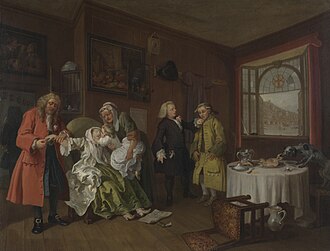 Gemäldezyklus «Mariage à la Mode», Szene (6): Selbstmord der Comtesse - William Hogarth (1743)
Der letzte Widerstand - William Hogarth (1759)