Landschaft mit Wasserfall
Jacob Isaacksz. van Ruisdael · 1668
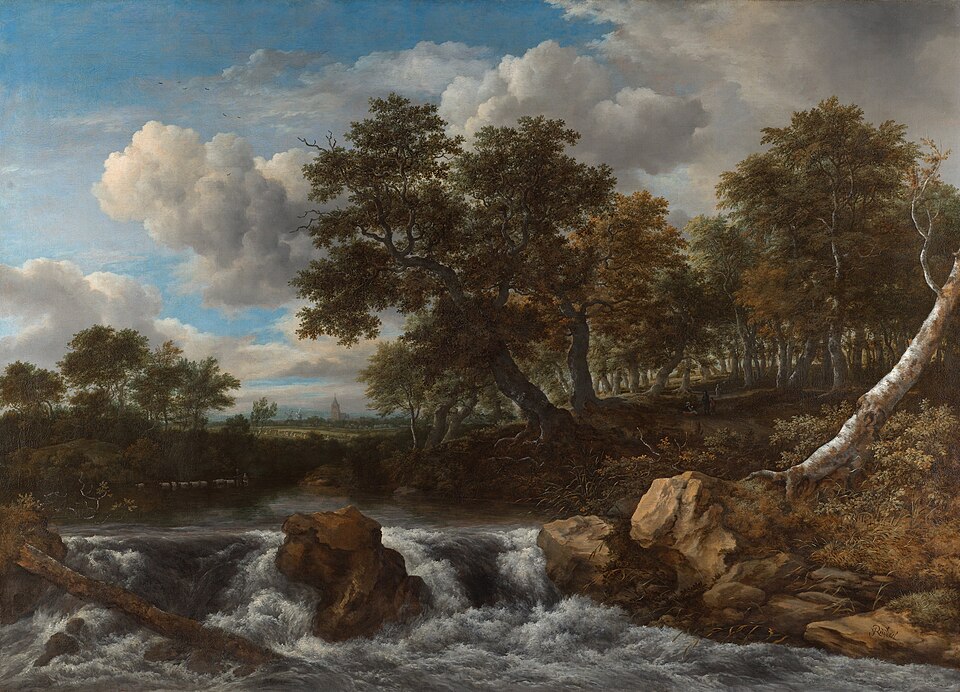
Water splits around a rock and crashes into the foreground, while far away the evening sun falls on a cornfield, windmills and a church. Ruisdael's waterfall is one of his largest pictures, and a quiet reminder of nature's force.
The story behind the painting
This oil painting by Jacob van Ruisdael is dated to the 1660s in the source, while Wikidata gives 1668. Its Dutch title adds a detail: landscape with waterfall, a church in the distance. According to the dealer John Smith, quoted by Hofstede de Groot in 1911, an ancestor of Sir Charles Blount bought it on the Continent around 1740. Blount sold it to Smith in 1836, and Smith sold it in 1837 to Adriaan van der Hoop in Amsterdam.
What to look for
In the left foreground a waterfall is divided in the middle by a rock, with a tree trunk lying half in the stream. On the right a rocky bank holds a birch bent to the right. Beyond is a great oak wood crossed by a road, where a man and a boy talk with a woman nursing a child. Two men drive sheep through the stream. In the centre a cornfield with sheaves opens onto a village with two windmills and a church, under rolling evening clouds.
Meaning and intent
Ruisdael painted many similar waterfalls. These pictures often include logs or broken stumps as silent witnesses to floods stronger than the one we see, a warning about the forces of nature. They must have sold well, since most of what survives of his work is waterfall scenes. Inspired by the dramatic pictures of Allaert van Everdingen, he also painted more Nordic versions with pines and mountains. Here, though, the wild water sits next to farmland and a village, the calm human world just beyond the torrent.
Legacy
Smith praised it as one of the artist's largest works, grand and rich in composition, clear and brilliant in colour, a masterpiece. Today it measures about 142.5 by 196 cm. Hofstede de Groot noted a conflict: he saw canvas, though the Amsterdam catalogue called it oak panel. It was signed on a stone at lower right and shown in Amsterdam in 1845. Van der Hoop bequeathed it to the city of Amsterdam in 1854; it belongs to the Amsterdam Museum and is on loan to the Rijksmuseum.
Schon gewusst?
- Dated to the 1660s; Wikidata gives 1668.
- One of Ruisdael's largest works, about 142.5 by 196 cm.
- Bequeathed to Amsterdam by Adriaan van der Hoop in 1854.
- Owned by the Amsterdam Museum, on loan to the Rijksmuseum.
Über den Künstler
Jacob Isaacksz. van Ruisdael (1628-1682)
Landschaftsmalerei · Rijksmuseum · Amsterdam-Museum
Mehr von Jacob Isaacksz. van Ruisdael
 Die Mühle von Wijk - Jacob van Ruisdael (1670)
 Judenfriedhof - Jacob van Ruisdael (1650s)
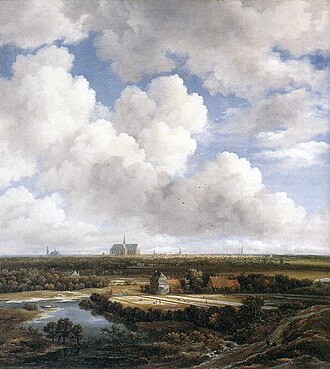 Die Bleichen bei Haarlem - Jacob van Ruisdael (1670)
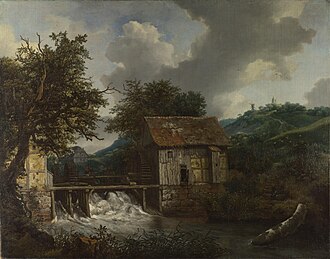 Zwei Wassermühlen und eine offene Schleuse in der Nähe von Singraven - Jacob van Ruisdael (1650)
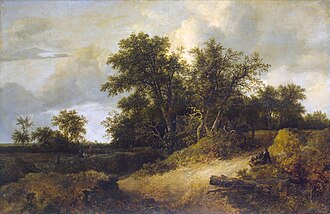 Dünenlandschaft - Jacob van Ruisdael (1646)
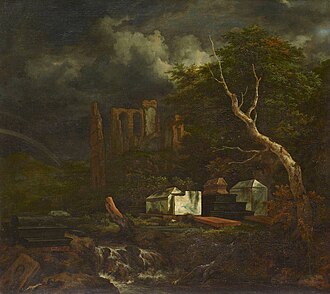 Der Judenfriedhof bei Ouderkerk - Jacob van Ruisdael (1653)
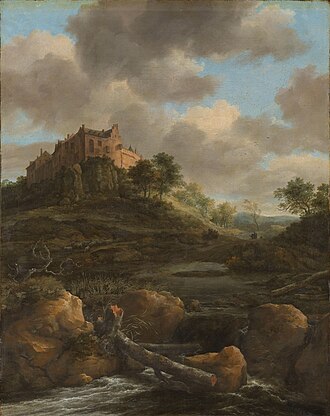 Burg Bentheim - Jacob van Ruisdael (1650s)
Ansicht von Egmond aan Zee - Jacob van Ruisdael (1650)
Werke verwandter Künstler
 Die Nachtwache - Rembrandt van Rijn (1642)
 Selbstbildnis - Rembrandt van Rijn (1659)
 Das Mädchen mit dem Perlenohrgehänge - Johannes Vermeer (1665)
 Dienstmagd mit Milchkrug - Johannes Vermeer (c. 1658)
 Fest des hl.Nikolaus - Jan Steen (1660s)
 Mädchen mit Austern. - Jan Steen (1658)
 Ein Schütze einen Berkemeyer haltend, bekannt als „Der fröhliche Trinker" - Frans Hals (1620s)
 Der lachende Kavalier - Frans Hals (1624)
 Hof eines Hauses in Delft - Pieter de Hooch (1658)
 A Woman Peeling Apples - Pieter de Hooch (1663)