Bauernhaus in Arles
Paul Gauguin · 1888
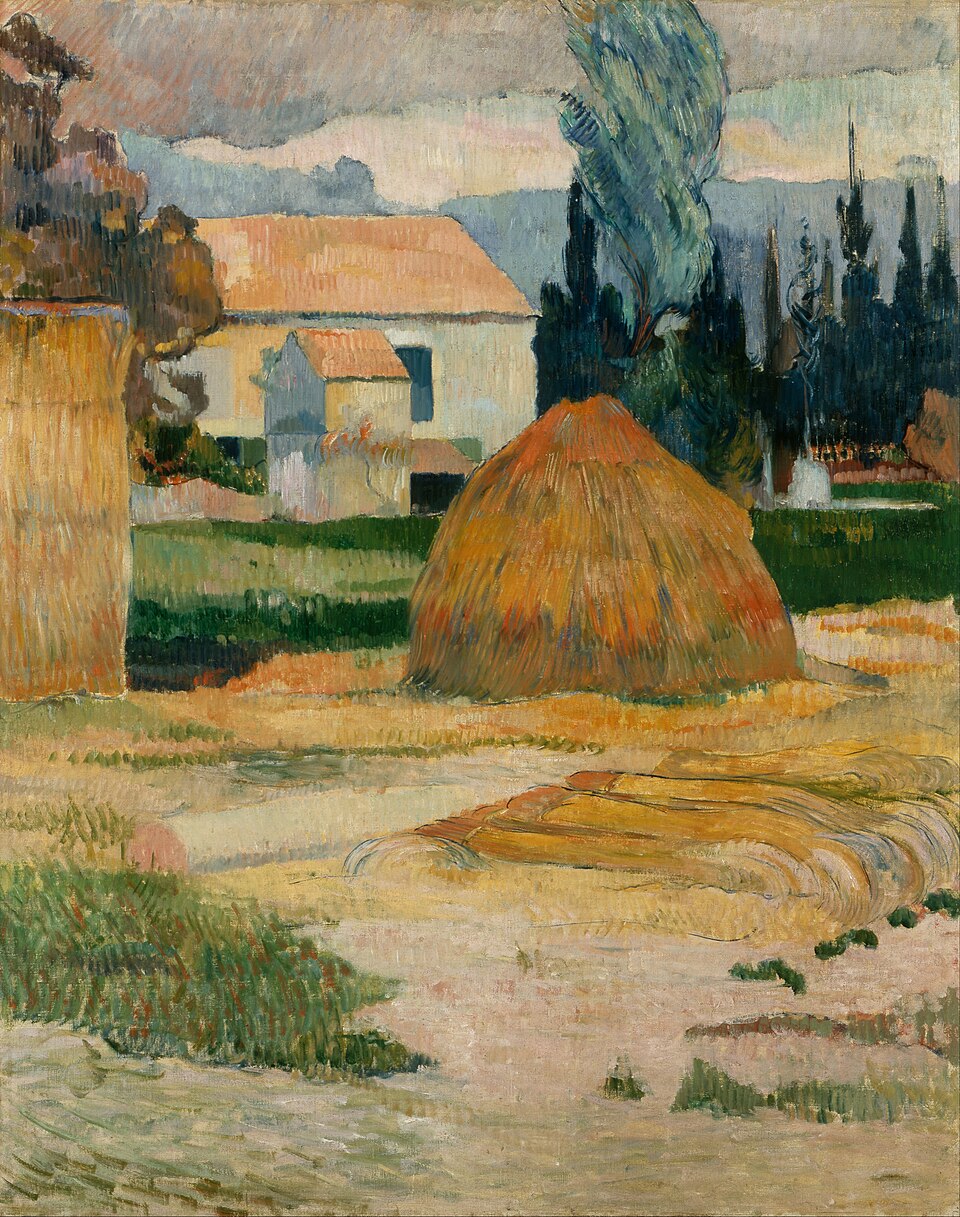
A farmhouse, cypresses and a haystack lock together like pieces of a puzzle under bright, acid colour. It was the first picture Gauguin painted in Arles, on a canvas Van Gogh had stretched for him.
The story behind the painting
For two months, ending at Christmas 1888, Gauguin and Vincent van Gogh lived together in Arles. Van Gogh eagerly hoped to found an artists' community in the region, a wish that led to some mutual accommodation between two strong personalities. This was the first painting Gauguin made during those months, on a linen canvas that Van Gogh stretched for him. The setting was one of Van Gogh's favourite places, the plains of the Crau. Their stormy relationship soon cut the partnership short.
What to look for
The canvas, about 91.5 by 72.5 cm, shows a typical scene of the region. The farmhouse is a traditional Provencal mas, cypress trees are common there, and the haystack suits the harvest season. Look at the emphasis on geometric forms and at the careful network of precisely placed brushstrokes that binds the haystack and the farmhouse together. Then notice the colours: only these bright, acidic hues reveal that Gauguin was painting beside Van Gogh.
Meaning and intent
Gauguin's treatment owes much to Paul Cezanne, whom he revered. Rather than recording the countryside as he found it, he organises it, so that nature itself seems to obey his own structural order. The result is a highly ordered world, calm, clear and carefully constructed. Despite the clash of their personalities, the period was productive for both, even if, according to Wikipedia, it ultimately had little effect on Gauguin's art.
Legacy
In February 1944 Mrs Julian Bobbs bought Landscape near Arles for the John Herron School of Art, as a gift in memory of her first husband, William Ray Adams. When the school and museum divided, the painting stayed with the Indianapolis Museum of Art, where it carries the accession number 44.10 and hangs in the Sidney and Kathy Taurel gallery. It keeps alive the first days of one of the most famous and difficult partnerships in the history of art.
Schon gewusst?
- Gauguin's first painting during his stay with Van Gogh in Arles, 1888.
- Painted on a linen canvas Van Gogh stretched for him.
- Its ordered structure owes much to Cezanne.
- In the Indianapolis Museum of Art since 1944.
Über den Künstler
Paul Gauguin (1848-1903)
Landschaftsmalerei · Himmel · Museo de Arte de Indianápolis · Zypressen · Gras · Kraut · Dieme
Mehr von Paul Gauguin
 Woher kommen wir? Wer sind wir? Wohin gehen wir? - Paul Gauguin (1897-1898)
 Der gelbe Christus - Paul Gauguin (1889)
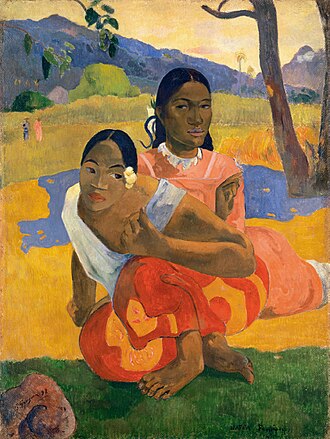 Nafea faa ipoipo - Paul Gauguin (1892)
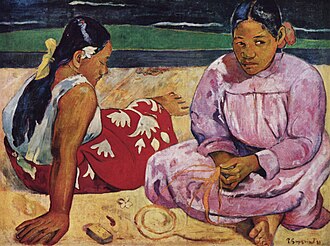 Frauen aus Tahiti - Paul Gauguin (1890)
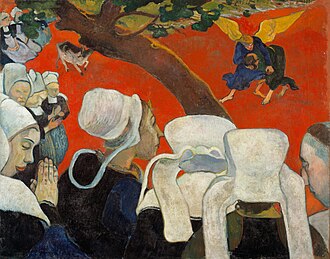 Vision nach der Predigt - Paul Gauguin (1888)
Manaò tupapaú - Paul Gauguin (1892)
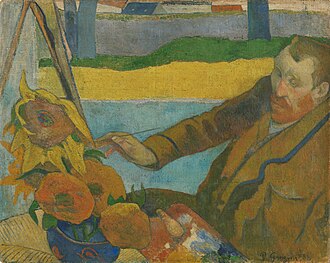 Porträt des Vincent van Gogh, Sonnenblumen malend - Paul Gauguin (1888)
 Gegrüßt seist du, Maria - Paul Gauguin (1891)
Werke verwandter Künstler
 Die Sternennacht - Vincent van Gogh (1889)
 Caféterrasse am Abend - Vincent van Gogh (1888)
 Strandspaziergang - Joaquín Sorolla (1909)
 Sad Inheritance - Joaquín Sorolla (1898)
 Die großen Badenden - Paul Cézanne (1900s)
 Der Knabe mit der roten Weste - Paul Cézanne
 Tanz im Moulin de la Galette - Pierre-Auguste Renoir (1876)
 Das Frühstück der Ruderer - Pierre-Auguste Renoir (1881)
 Das Promenoir des »Moulin Rouge« - Henri de Toulouse-Lautrec (1892)
 Die Toilette - Henri de Toulouse-Lautrec (1896)