Landschaft mit Schloss Auvers bei Sonnenuntergang
Vincent van Gogh · 1890
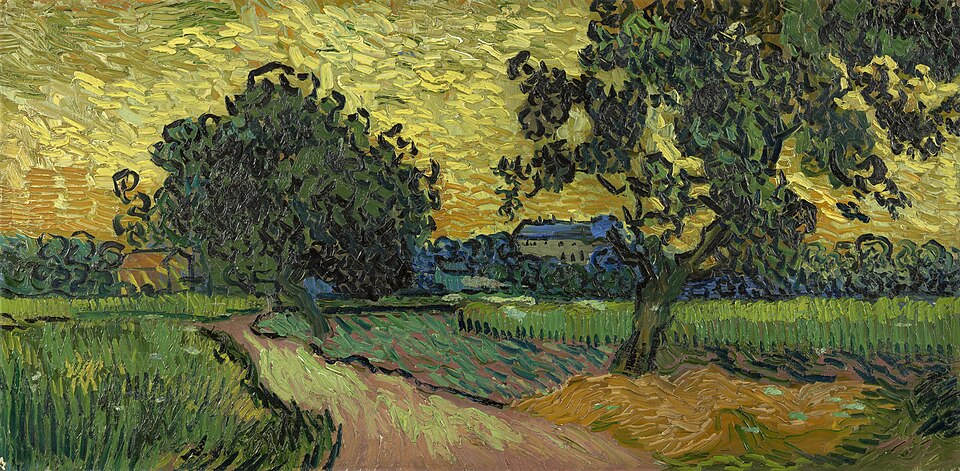
Two black pear trees stand against a sky turning gold, and far behind them a chateau sinks into dark woods. Van Gogh painted it in Auvers in June 1890, a few weeks before the end of his life.
The story behind the painting
Van Gogh spent the last months of his life in Auvers-sur-Oise, north of Paris. The painting is dated 20 to 22 June 1890. On 24 June he described it himself in a letter: at last an evening effect, two pear trees quite black against a yellowing sky, with wheat, and in the violet background the chateau set deep in the dark forest. The chateau, built in the seventeenth century, is the largest monument in Auvers, standing on a wooded hill above the valley of the Oise.
What to look for
The canvas is wide, in the format called double square. Wikipedia gives 50.2 by 101 cm, while Wikidata lists 50 by 107 cm. From June 1890 Van Gogh used this format for about thirty canvases, almost all landscapes, cutting the canvas himself from a large roll, and this is one of the first of the series. Look at the dark, tangled branches of the two trees against the luminous yellow sky, the wheat in the field, and the distant woods with the chateau.
Meaning and intent
It is the golden sky that gives the picture its character. Van Gogh was looking for effect more than for realism, and here the contrast between the black silhouettes and the glowing light carries the whole mood of the evening. The trees, the field and the chateau are simple elements, but the colour turns them into a moment of stillness at the close of day. Knowing that he would die only weeks later, it is hard not to feel the weight of that fading light.
Legacy
By the end of June 1890 the painting belonged to his brother Theo, then to Theo's widow Jo van Gogh-Bonger and their son Vincent Willem van Gogh. It was lent many times to the Rijksmuseum in Amsterdam, then given in 1952 to the first Vincent van Gogh foundation, later passing to the Theo van Gogh foundation and the new Vincent van Gogh Foundation. It was on permanent loan to the Rijksmuseum from 1973, and since 1994 it has been on permanent loan to the Van Gogh Museum in Amsterdam.
Schon gewusst?
- Painted 20-22 June 1890 at Auvers-sur-Oise.
- Van Gogh described it in a letter of 24 June 1890.
- One of the first of about thirty double-square canvases.
- On permanent loan to the Van Gogh Museum since 1994.
Über den Künstler
Vincent van Gogh (1853-1890)
Landschaftsmalerei · Van Gogh Museum
Mehr von Vincent van Gogh
 Die Sternennacht - Vincent van Gogh (1889)
 Caféterrasse am Abend - Vincent van Gogh (1888)
 Sonnenblumen - Vincent van Gogh (1888)
 Mandelblüte - Vincent van Gogh (1890)
 Weizenfeld mit Raben - Vincent van Gogh (1890)
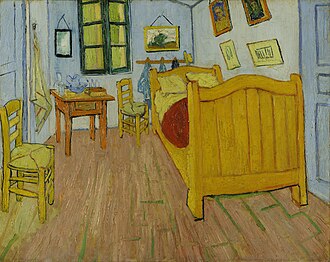 Das Schlafzimmer - Vincent van Gogh (1888)
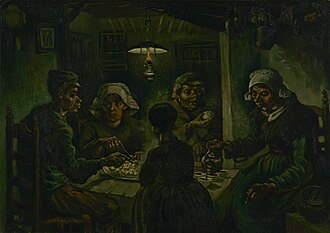 Die Kartoffelesser - Vincent van Gogh (1885)
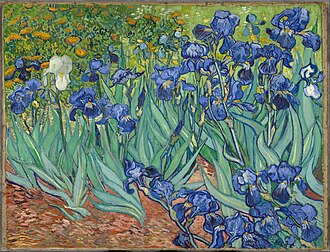 Schwertlilien - Vincent van Gogh (1889)
Werke verwandter Künstler
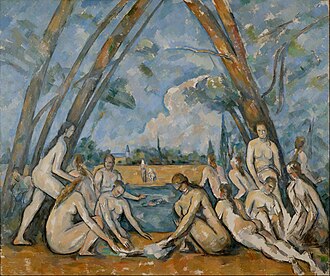 Die großen Badenden - Paul Cézanne (1900s)
 Der Knabe mit der roten Weste - Paul Cézanne
 Woher kommen wir? Wer sind wir? Wohin gehen wir? - Paul Gauguin (1897-1898)
 Der gelbe Christus - Paul Gauguin (1889)
 Die Aufrichtung des Kreuzes - Peter Paul Rubens (1609)
 Der Raub der Töchter des Leukippos - Peter Paul Rubens (1618)
 Strandspaziergang - Joaquín Sorolla (1909)
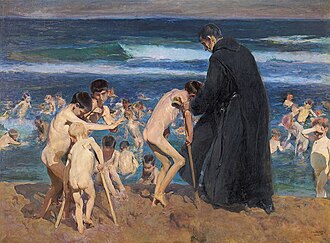 Sad Inheritance - Joaquín Sorolla (1898)
 Tanz im Moulin de la Galette - Pierre-Auguste Renoir (1876)
 Das Frühstück der Ruderer - Pierre-Auguste Renoir (1881)
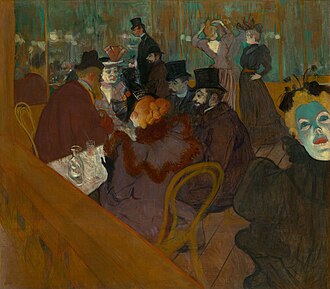 Das Promenoir des »Moulin Rouge« - Henri de Toulouse-Lautrec (1892)
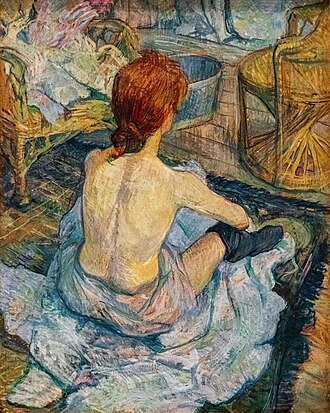 Die Toilette - Henri de Toulouse-Lautrec (1896)