La bata rosa
Joaquín Sorolla · 1916
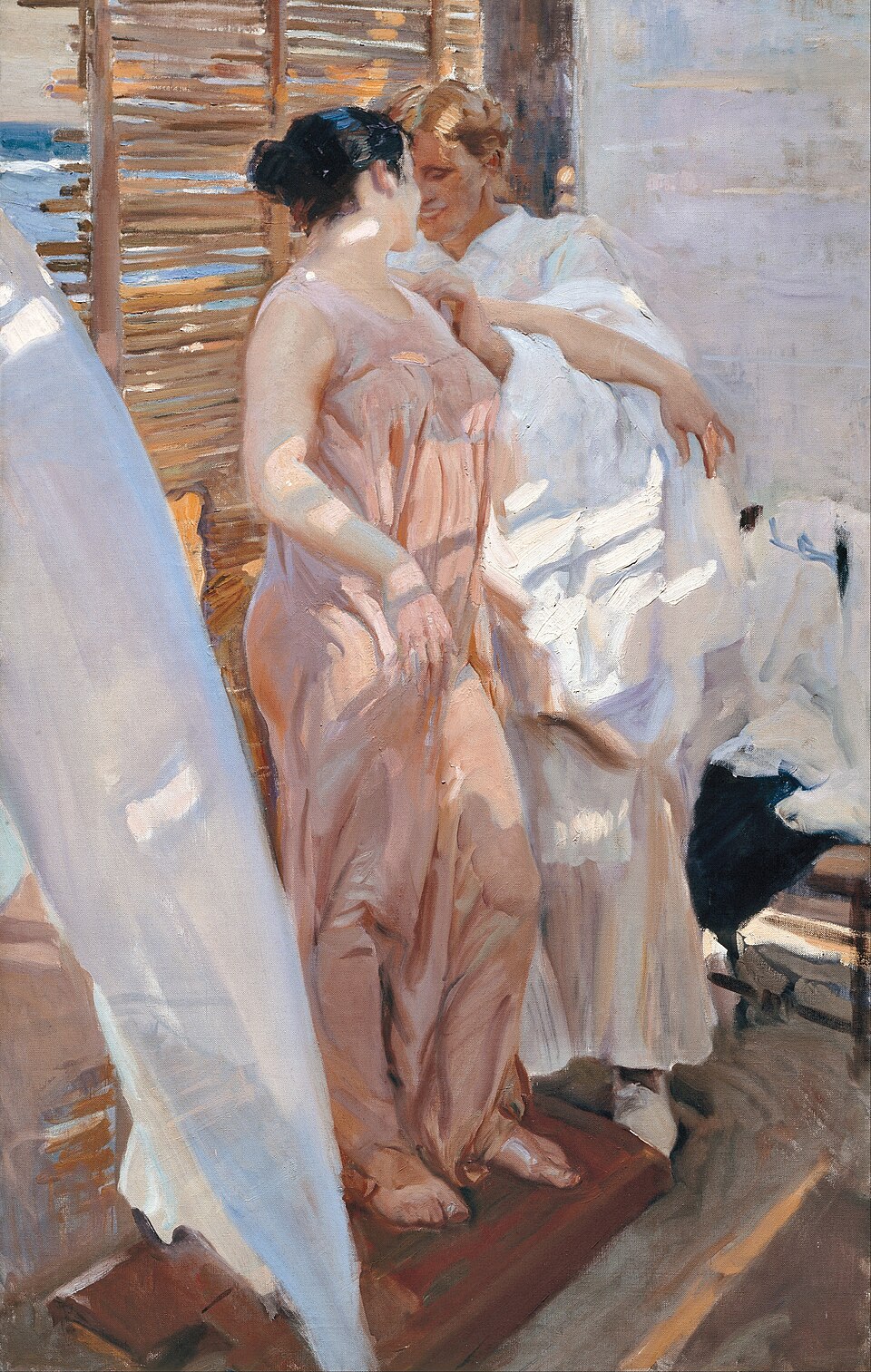
In a beach hut in Valencia, one woman helps another out of a wet bathing gown, and the light pours in from every side. Sorolla painted it in 1916, and it is often seen as the work where he fully earned his name, the painter of light.
The story behind the painting
Around the turn of the twentieth century, pink gowns were a common sight on the beaches of Valencia. Children of workers and fishermen usually bathed naked until four or five; after that, boys kept bathing naked into adolescence, while girls wore a pink or white gown. Sorolla painted several canvases on this theme. This one, dated 1916 from its signature, is described as one of his masterpieces, the picture in which he reached full maturity. It is also known as Leaving the Bath and After the Bath.
What to look for
The scene is an everyday moment inside a beach shelter. An older woman helps a younger one take off a bathing gown that is still wet. The figures stand against the light. The folds of the cloth recall the wet drapery of Greek sculpture, and the rounded bodies and their pose recall the Three Graces. Light comes in through the cane screen and the openings in the roof, filters through the fabrics, bounces off the white tunics and reaches the women from all sides.
Meaning and intent
Sorolla seems to want every kind of light at once here: backlight, reflected light, direct light, filtered light, natural light. The brushstrokes are quick, firm and fleeting, as if trying to hold on to the passing brightness of a single moment. A small domestic gesture, a helping hand with a wet garment, becomes a study of how sunlight behaves inside a shaded room. The classical echoes give that modest gesture a quiet dignity without turning the women into goddesses.
Legacy
The canvas is large, more than two metres high and almost 1.30 metres wide, about 208 by 126.5 cm. Its size suggests that Sorolla was influenced by his commission from the Hispanic Society of New York, Vision of Spain, a set of large murals that had occupied him since 1912. The painting is kept today in the Sorolla Museum in Madrid, where visitors can stand before it at full height and feel the light of a Valencian beach move across the cloth.
Schon gewusst?
- Dated 1916 from the signature.
- Also known as Leaving the Bath and After the Bath.
- About 208 by 126.5 cm.
- Kept in the Sorolla Museum, Madrid.
Über den Künstler
Joaquín Sorolla (1863-1923)
Post-Impressionismus · Museo Sorolla · Liebe
Mehr von Joaquín Sorolla
 Strandspaziergang - Joaquín Sorolla (1909)
 Sad Inheritance - Joaquín Sorolla (1898)
 Kinder am Strand - Joaquín Sorolla (1910)
 White slave trade - Joaquín Sorolla (1894)
 And They Still Say Fish is Expensive! - Joaquín Sorolla (1894)
 Die Heimkehr der Fischer - Joaquín Sorolla (1894)
 Seilspringen. La Granja - Joaquín Sorolla (1911)
 After Bathing - Joaquín Sorolla (1915)
Werke verwandter Künstler
 Die Sternennacht - Vincent van Gogh (1889)
 Caféterrasse am Abend - Vincent van Gogh (1888)
 Woher kommen wir? Wer sind wir? Wohin gehen wir? - Paul Gauguin (1897-1898)
 Der gelbe Christus - Paul Gauguin (1889)
 Die großen Badenden - Paul Cézanne (1900s)
 Der Knabe mit der roten Weste - Paul Cézanne
 Tanz im Moulin de la Galette - Pierre-Auguste Renoir (1876)
 Das Frühstück der Ruderer - Pierre-Auguste Renoir (1881)
 Das Promenoir des »Moulin Rouge« - Henri de Toulouse-Lautrec (1892)
 Die Toilette - Henri de Toulouse-Lautrec (1896)