Hendrickje with Fur Wrap
Rembrandt van Rijn · 1659
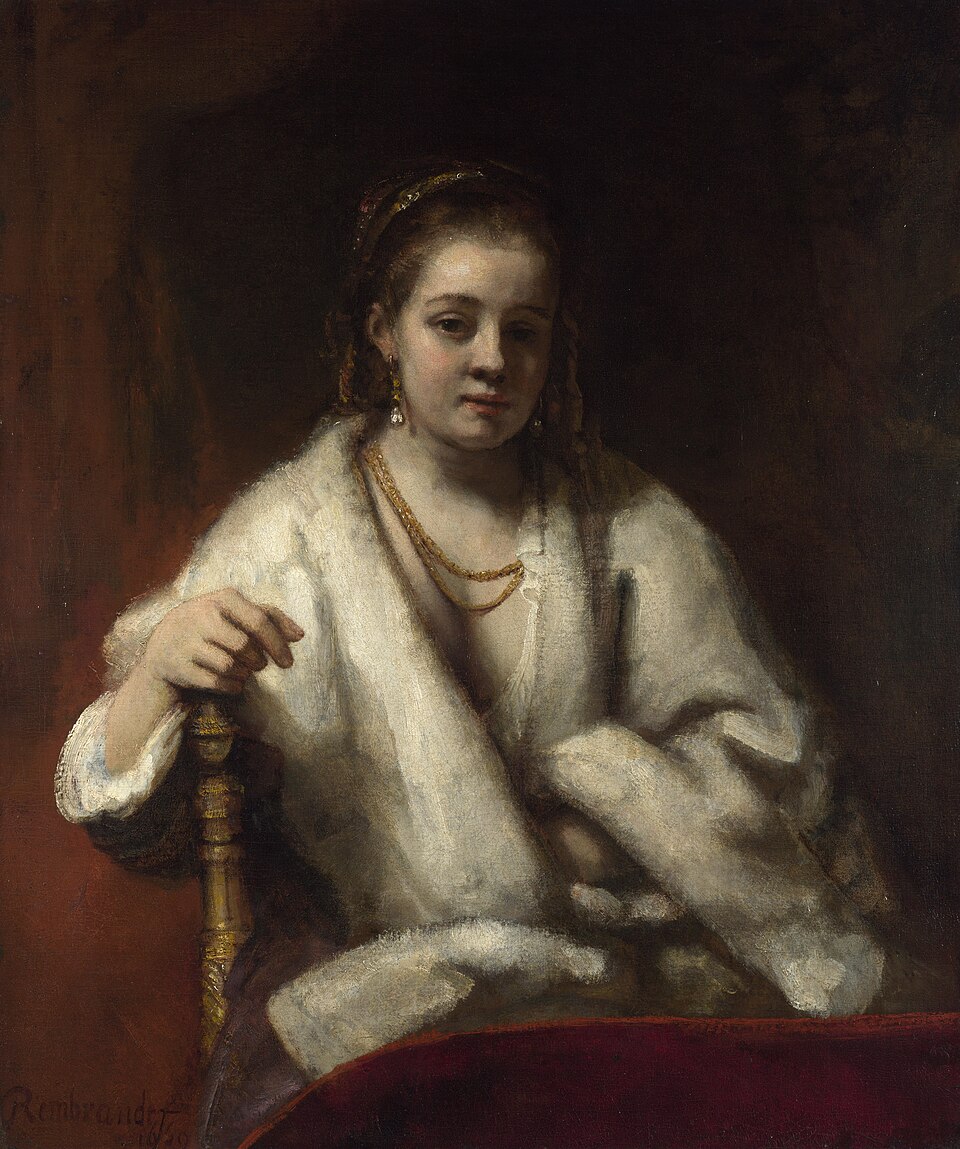
Hendrickje Stoffels sits in a fur mantle and fine jewels, her chemise loosely open, one arm resting on the chair. She shared Rembrandt's life and bore his daughter, and he painted her with rare tenderness.
The story behind the painting
Hendrickje Stoffels was Rembrandt's housekeeper, his companion and the mother of his daughter. They met in 1647. Wikipedia says this oil on canvas was painted between 1654 and 1656, seven to nine years after they met, while Wikidata gives 1659. It is one of several paintings believed to show her, since no picture of her is universally agreed. Its later history begins in Amsterdam, where the merchant Edward Gray bought it in 1817; James Morrison acquired it from Gray's estate in 1838.
What to look for
She sits on a chair, wearing a fur mantle and expensive jewellery. Her chemise lies open loosely over her bosom, and her right arm rests along the top of the chair. Look at how relaxed the pose is: this is not a formal portrait of a lady of rank but someone at ease in front of a painter who knows her well. The canvas is about 101.9 by 83.7 cm. When the National Gallery received it, heavy varnish covered the surface, and it was removed before the picture went on view.
Meaning and intent
Because Hendrickje was so close to Rembrandt, a portrait like this is also a glimpse into his private life. The open chemise, the warm fur and the precious ornaments together make an image both intimate and rich. Richard Cork of the Evening Standard wrote that even under the varnish it was obvious this was one of Rembrandt's most personal and successful mature paintings. The Times' Geraldine Norman called it a great portrait of the artist's mistress, words that show how the picture is read through their bond.
Legacy
The painting stayed in the Morrison family trust for generations and spent several years in a bank vault. Mary Dent-Brocklehurst inherited it in 1968 after the death of her brother Simon Morrison. In 1976 the National Gallery in London acquired it with a contribution from the Art Fund. The Times put the news on its front page, and Geraldine Norman called it probably the gallery's most significant acquisition since Titian's Death of Actaeon in 1971.
Schon gewusst?
- Shows Hendrickje Stoffels, Rembrandt's companion and mother of his daughter.
- Wikipedia dates it 1654-1656; Wikidata gives 1659.
- Bought by the merchant Edward Gray in Amsterdam in 1817.
- In the National Gallery, London, since 1976.
Über den Künstler
Rembrandt van Rijn (1606-1669)
Mehr von Rembrandt van Rijn
 Die Nachtwache - Rembrandt van Rijn (1642)
 Selbstbildnis - Rembrandt van Rijn (1659)
 Die Anatomie des Dr. Tulp - Rembrandt van Rijn (1632)
 Die Judenbraut - Rembrandt van Rijn (1660s)
 Der Sturm auf dem See Genesareth - Rembrandt van Rijn (1633)
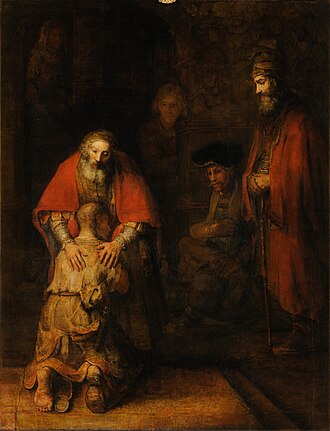 Die Rückkehr des verlorenen Sohnes - Rembrandt van Rijn (1668)
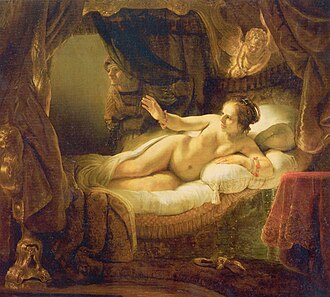 Danaë - Rembrandt van Rijn (1636)
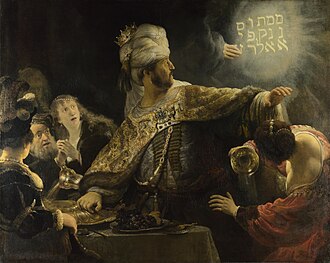 Das Gastmahl des Belsazar - Rembrandt van Rijn (1636)
Werke verwandter Künstler
 Das Mädchen mit dem Perlenohrgehänge - Johannes Vermeer (1665)
 Dienstmagd mit Milchkrug - Johannes Vermeer (c. 1658)
 Fest des hl.Nikolaus - Jan Steen (1660s)
 Mädchen mit Austern. - Jan Steen (1658)
 Ein Schütze einen Berkemeyer haltend, bekannt als „Der fröhliche Trinker" - Frans Hals (1620s)
 Der lachende Kavalier - Frans Hals (1624)
 Die Mühle von Wijk - Jacob van Ruisdael (1670)
 Judenfriedhof - Jacob van Ruisdael (1650s)
 Hof eines Hauses in Delft - Pieter de Hooch (1658)
 A Woman Peeling Apples - Pieter de Hooch (1663)