Grünes Weizenfeld mit Zypresse
Vincent van Gogh · 1889
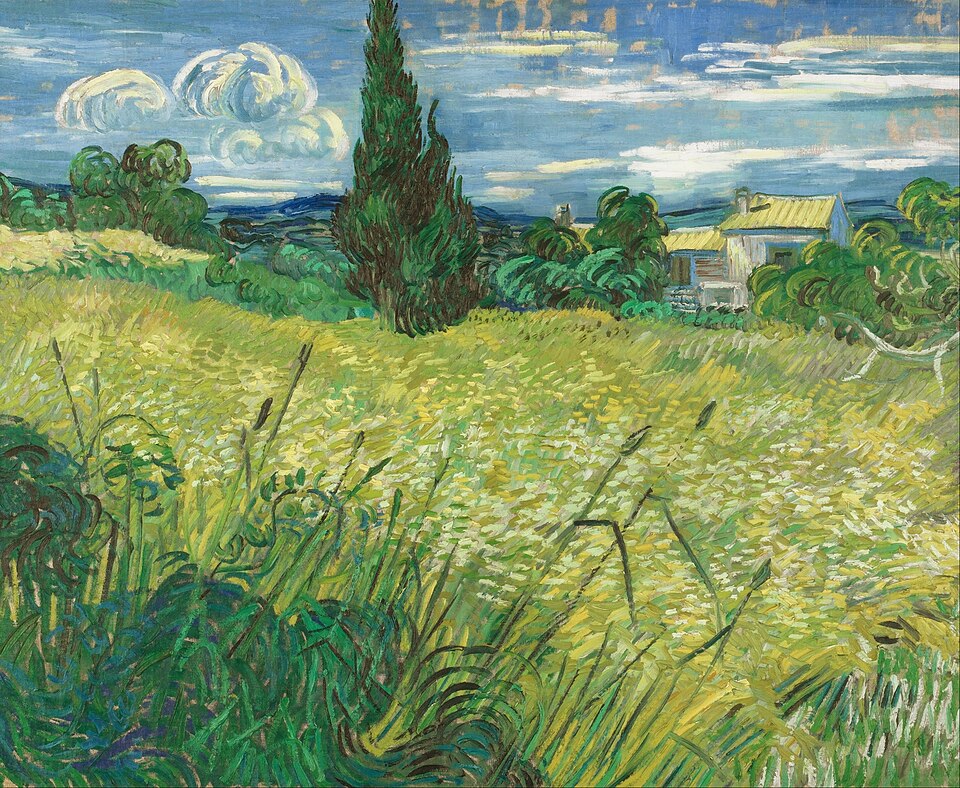
A dark cypress rises like a flame beside a little house, wheat turning from green to gold around it. Van Gogh painted it days after he was allowed out of the asylum to work in the open air.
The story behind the painting
In 1889 Vincent van Gogh was voluntarily living at the asylum of Saint-Paul near Saint-Rémy in Provence. In June he was finally allowed out to paint en plein air, and within a few days he had finished this canvas. On 16 June he wrote to his sister Wil describing it: a field of yellowing wheat edged with brambles and green bushes, a little pink house, and a tall dark cypress standing out against purplish, bluish hills and a forget-me-not blue sky streaked with pink. In early July he sent an ink drawing of the composition to his brother Theo, and he probably sent the painting itself to Theo that September.
What to look for
Let your eye travel up from the wheat. Most of the field is still green, but patches are already ripening to yellow, the tones Van Gogh compared to the warm crust of a loaf of bread. At the centre stands the tall, slender cypress, almost black, beside a small house. Behind them rise the mountains, and above, a blue sky with white clouds. Look closely at the surface: the art historian Ronald Pickvance noted that, compared with the Impressionists, Van Gogh used colour more locally and laid his brushstrokes in a more organic, vigorously hatched way, so the whole field seems to move.
Meaning and intent
Wheat fields mattered deeply to Van Gogh. He painted them dozens of times, and for him they symbolised the cycle of life and death; he found in them both comfort and inspiration. Cypresses were another enduring fondness during his time in Provence. What is striking here is the calm. Pickvance observed that the painting has no spatial distortions, no overheated colours and no revolutionary symbolism, and that it shows neither psychological tension nor a morbid vision. Painted in an asylum, it is nonetheless a picture of balance and quiet attention, a man rediscovering the open landscape after confinement.
Legacy
The painting belongs to the National Gallery Prague and hangs in the Trade Fair Palace in the Holešovice district, where it is known simply as Green Wheat. It sits within a group of wheat field and cypress pictures that Van Gogh made as the summer of 1889 turned the crops gold, a series that has become central to how we picture his Provençal years. The ink drawing he sent to Theo survives too, now in the Morgan Library and Museum in New York, so viewers can compare how he translated the same scene into line and into colour.
Schon gewusst?
- Van Gogh described this painting in a letter to his sister Wil on 16 June 1889.
- He painted it at Saint-Rémy, shortly after being allowed to work outside the asylum.
- An ink drawing of the composition is in the Morgan Library and Museum, New York.
- In Prague the painting is known simply as Green Wheat.
Über den Künstler
Vincent van Gogh (1853-1890)
Landschaftsmalerei · Acker · Zypressen
Mehr von Vincent van Gogh
 Die Sternennacht - Vincent van Gogh (1889)
.jpg) Caféterrasse am Abend - Vincent van Gogh (1888)
Caféterrasse am Abend - Vincent van Gogh (1888) Sonnenblumen - Vincent van Gogh (1888)
 Mandelblüte - Vincent van Gogh (1890)
 Weizenfeld mit Raben - Vincent van Gogh (1890)
 Das Schlafzimmer - Vincent van Gogh (1888)
 Die Kartoffelesser - Vincent van Gogh (1885)
 Schwertlilien - Vincent van Gogh (1889)
Werke verwandter Künstler
 Woher kommen wir? Wer sind wir? Wohin gehen wir? - Paul Gauguin (1897-1898)
%201889.jpg) Der gelbe Christus - Paul Gauguin (1889)
Der gelbe Christus - Paul Gauguin (1889) Das Frühstück im Grünen - Édouard Manet (1863)
 Olympia - Édouard Manet (1863)