Junges Mädchen, vor einem Weizenfeld stehend
Vincent van Gogh · 1890
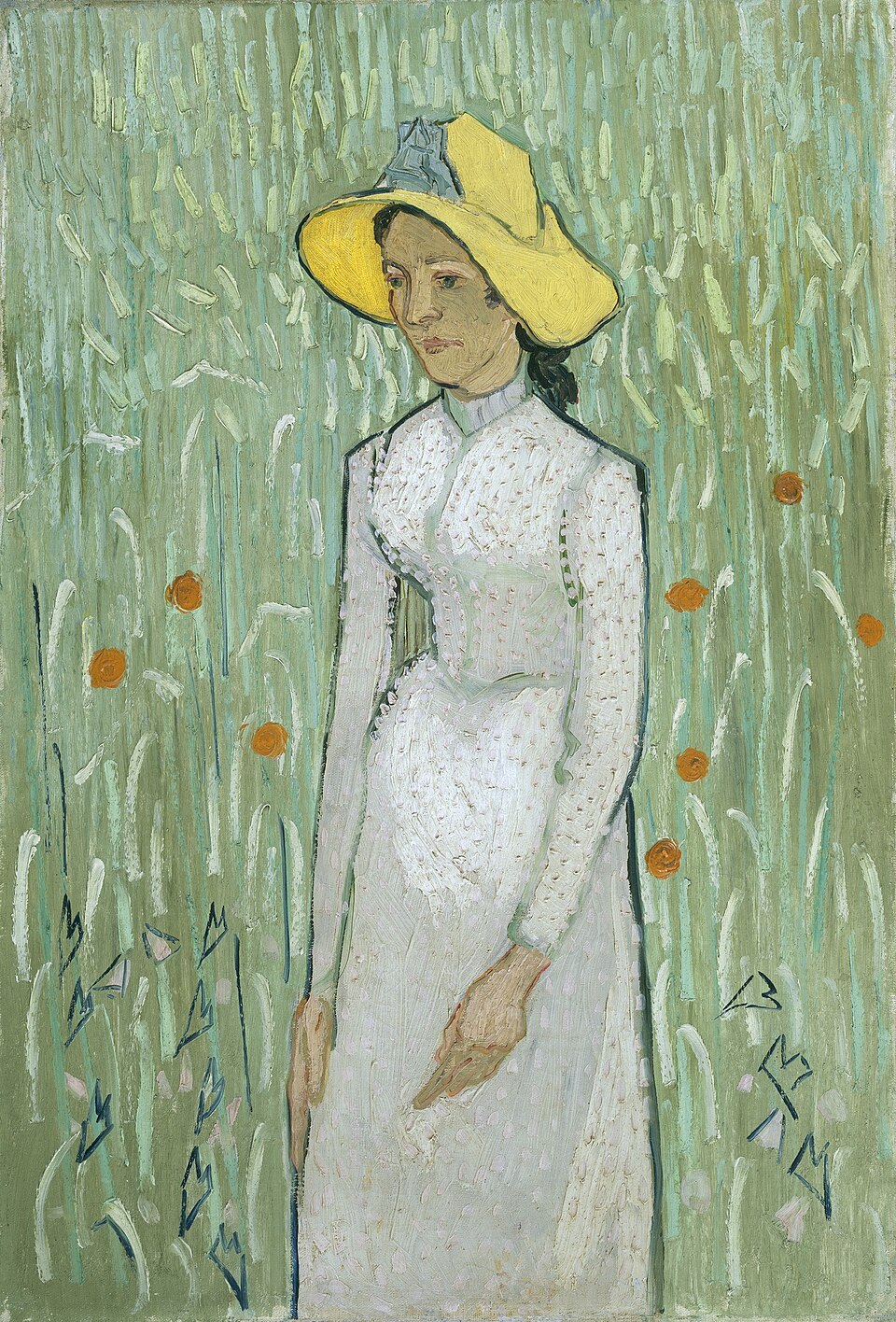
She stands so close she almost fills the canvas, yet her shadowed eyes seem to look somewhere far away: one of the quiet faces from Van Gogh's last summer.
The story behind the painting
Girl in White, also called Young Girl Standing Against a Background of Wheat, was painted in 1890 in Auvers-sur-Oise, during the last months of Van Gogh's life. In May he had left Saint-Rémy, spent three restless days in Paris with his brother Theo, Theo's wife Johanna and their baby, and then settled in Auvers under the care of Dr Paul Gachet. For a while he seemed better, working at astonishing speed: from May until his death on 29 July he made about seventy paintings, more than one a day. Yet worries gathered around him, from the baby's illness to Theo's job troubles, and after a family visit to Paris he wrote that he could see no future at all.
What to look for
Notice first how much of the picture the young woman occupies. Van Gogh lets her fill most of the pictorial space, which pulls her very close to us, standing against a background of wheat. Then look at her face. He shadowed it and gave her what writers have called a distant, unfocused gaze. The combination is unsettling in a gentle way: she is physically near, almost within reach, yet emotionally she seems elsewhere. Van Gogh described a similar sitter from these weeks as a peasant woman with a big yellow hat and a knot of sky-blue ribbons, and the same woman appears in another Auvers painting, possibly Young Peasant Woman with Straw Hat Sitting in the Wheat.
Meaning and intent
Art historians have pointed to this work as an example of how a painter uses the picture plane to shape our relationship with a subject. By bringing the woman close while keeping her gaze withdrawn, Van Gogh makes her emotional distance poignant. Later writers on modern art compared Girl in White with a carefully detailed academic portrait of 1900, arguing that Van Gogh's more direct, simplified vision carries richer feeling than skilful literal likeness. It is hard not to read the painting against the darkening mood of his final weeks, but the canvas itself offers no story, only a person standing in the wheat, present and unreachable at once.
Legacy
After Van Gogh's death the painting stayed with his sister-in-law Johanna van Gogh-Bonger, who sold it in 1908. It then passed through dealers and collectors in The Hague and Zürich before the New York collector Chester Dale acquired it in 1951. Dale bequeathed it to the National Gallery of Art in Washington, D.C., where it has been part of the Chester Dale Collection since 1963. Wikidata records the museum under its Spanish name, Galería Nacional de Arte. Today the portrait stands as a tender witness to the burst of work in Auvers: a reminder that even in his last weeks, Van Gogh kept looking hard at ordinary people.
Schon gewusst?
- The painting is also known as Young Girl Standing Against a Background of Wheat and Woman in a Cornfield.
- In Auvers, Van Gogh made about 70 paintings between May and his death on 29 July 1890.
- It has been in the Chester Dale Collection at the National Gallery of Art, Washington, since 1963.
Über den Künstler
Vincent van Gogh (1853-1890)
Porträt · National Gallery of Art · Mädchen
Mehr von Vincent van Gogh
 Die Sternennacht - Vincent van Gogh (1889)
.jpg) Caféterrasse am Abend - Vincent van Gogh (1888)
Caféterrasse am Abend - Vincent van Gogh (1888) Sonnenblumen - Vincent van Gogh (1888)
 Mandelblüte - Vincent van Gogh (1890)
 Weizenfeld mit Raben - Vincent van Gogh (1890)
 Das Schlafzimmer - Vincent van Gogh (1888)
 Die Kartoffelesser - Vincent van Gogh (1885)
 Schwertlilien - Vincent van Gogh (1889)
Werke verwandter Künstler
 Woher kommen wir? Wer sind wir? Wohin gehen wir? - Paul Gauguin (1897-1898)
%201889.jpg) Der gelbe Christus - Paul Gauguin (1889)
Der gelbe Christus - Paul Gauguin (1889) Das Frühstück im Grünen - Édouard Manet (1863)
 Olympia - Édouard Manet (1863)