Mädchen im Bilderrahmen
Rembrandt van Rijn · 1641
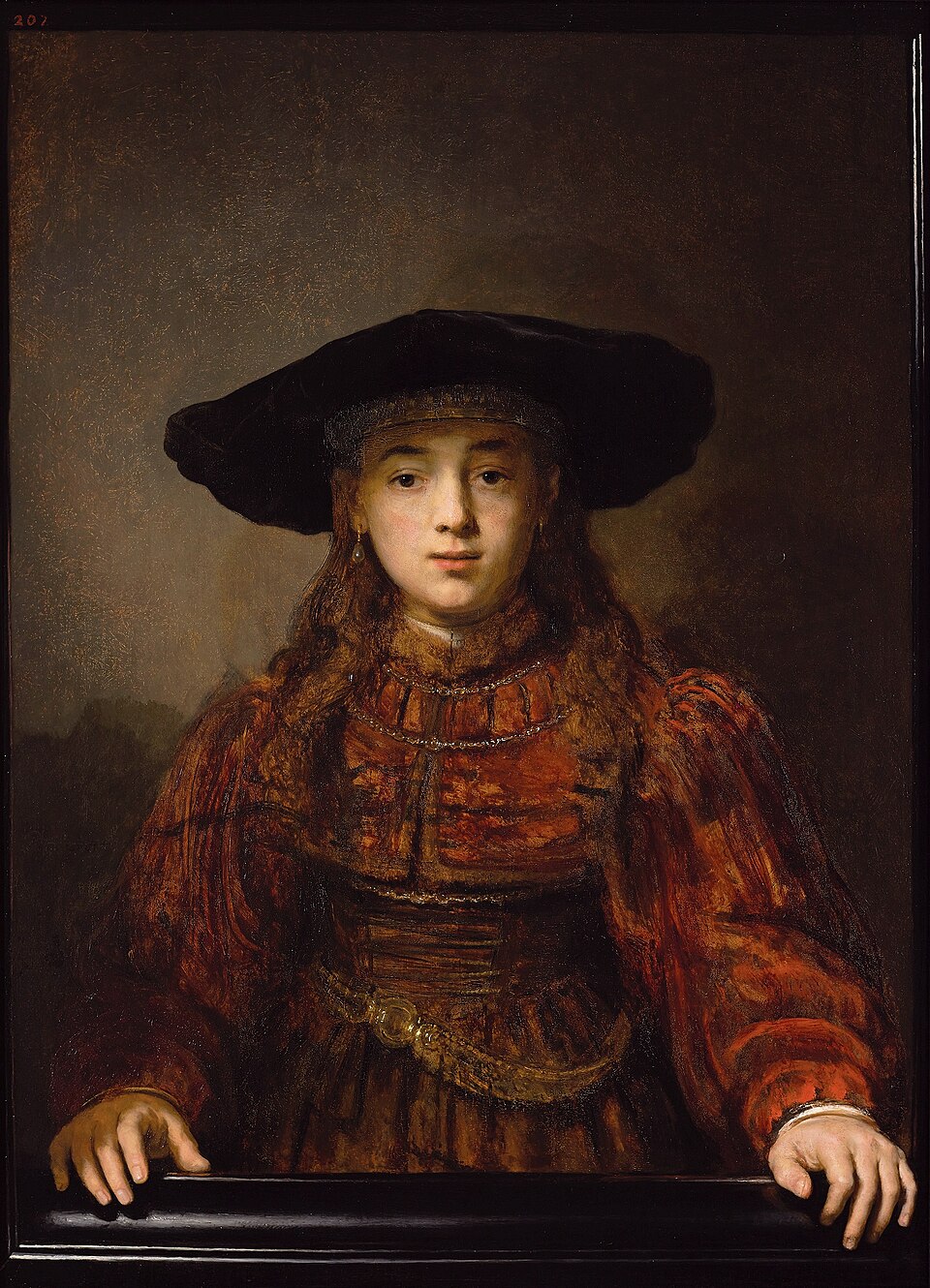
A young woman leans at the edge of a painted frame, her hands slipping past it into our space. Seized by the Gestapo, hidden in a Swiss vault, then given to Warsaw, Rembrandt's girl has travelled far.
The story behind the painting
Rembrandt painted The Girl in a Picture Frame in 1641, in oil on panel. It is also known as The Jewish Bride and The Girl in a Hat. X-rays revealed that he had first begun a different picture on the same panel: a seated woman in the fashion of the time, with a millstone ruff and a small bonnet, placed further to the right. That portrait was never finished and the panel was reused. Rembrandt is not known ever to have reused a started panel for a client's commission, which supports the idea that this is not a portrait at all.
What to look for
The sitter is framed by a feigned picture frame, of which only the bottom and right side are visible. She wears a dark red velvet dress, a black hat and pear-shaped pearl earrings. Her right arm draws slightly back and her right hand seems suspended just above the edge of the frame, while the pearl at her ear and the fabric of her sleeve seem to move. Both hands reach beyond the frame, breaking the usual space of a picture. The panel measures about 105.5 by 76 cm according to Wikidata. After the 2005 to 2006 restoration, Rembrandt's own brushwork on the chest and sleeve became visible again.
Meaning and intent
This is a tronie, a study of a head or half-figure without attributes or action, rather than a portrait. Her costume was not fashionable in 1641; it was the kind of ancient attire used for mythical, historical or biblical subjects. The name Jewish Bride was in use from at least 1769, linked to the tradition that a bride wore her hair loose when signing the marriage contract. Ernst van de Wetering sees the painting as a typical example of Rembrandt's interest in trompe l'oeil in the late 1630s and early 1640s and his search for ways to show movement, possibly the prototype of that brief fascination.
Legacy
King Stanislaw August Poniatowski bought it in 1777 together with The Scholar at the Lectern. It later passed to the Lanckoronski family, and Count Karol Lanckoronski showed it in his Vienna palace from 1902. The Gestapo seized it during the Second World War; in 1947 it was returned to the family and placed in a Swiss bank vault. After a 1994 exhibition at the Royal Castle in Warsaw, Karolina Lanckoronska donated it to the castle. Its authorship was sometimes questioned, but in February 2006 the Rembrandt Research Project confirmed it, and it travelled to Amsterdam and Berlin for the 400th anniversary of Rembrandt's birth.
Schon gewusst?
- Painted in 1641, oil on panel.
- Also called The Jewish Bride and The Girl in a Hat.
- Confirmed as Rembrandt's by the Rembrandt Research Project in 2006.
- Donated to the Royal Castle in Warsaw by Karolina Lanckoronska.
Über den Künstler
Rembrandt van Rijn (1606-1669)
Porträt · Niederländisches Goldenes Zeitalter der Malerei · Mädchen · Munich Central Collecting Point
Mehr von Rembrandt van Rijn
 Die Nachtwache - Rembrandt van Rijn (1642)
 Selbstbildnis - Rembrandt van Rijn (1659)
 Die Anatomie des Dr. Tulp - Rembrandt van Rijn (1632)
 Die Judenbraut - Rembrandt van Rijn (1660s)
 Der Sturm auf dem See Genesareth - Rembrandt van Rijn (1633)
 Die Rückkehr des verlorenen Sohnes - Rembrandt van Rijn (1668)
 Danaë - Rembrandt van Rijn (1636)
 Das Gastmahl des Belsazar - Rembrandt van Rijn (1636)
Werke verwandter Künstler
 Das Mädchen mit dem Perlenohrgehänge - Johannes Vermeer (1665)
 Dienstmagd mit Milchkrug - Johannes Vermeer (c. 1658)
 Fest des hl.Nikolaus - Jan Steen (1660s)
 Mädchen mit Austern. - Jan Steen (1658)
 Ein Schütze einen Berkemeyer haltend, bekannt als „Der fröhliche Trinker" - Frans Hals (1620s)
 Der lachende Kavalier - Frans Hals (1624)
 Die Mühle von Wijk - Jacob van Ruisdael (1670)
 Judenfriedhof - Jacob van Ruisdael (1650s)
 Hof eines Hauses in Delft - Pieter de Hooch (1658)
 A Woman Peeling Apples - Pieter de Hooch (1663)