Saskia als Flora
Rembrandt van Rijn · 1634
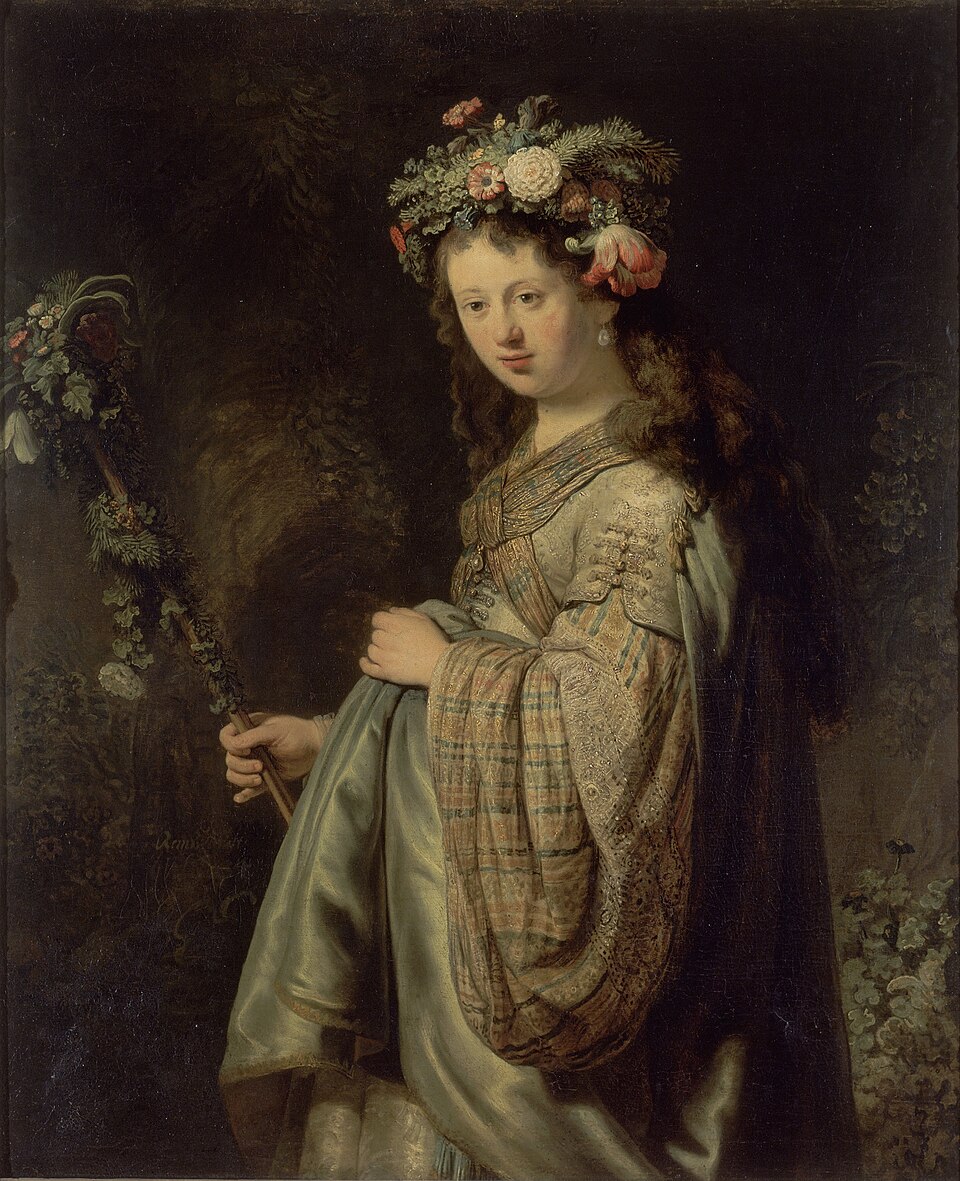
In the year of his marriage, Rembrandt crowned his young wife with flowers and turned her into the goddess of spring.
The story behind the painting
Rembrandt painted this Flora in Amsterdam in 1634, at a time when the young artist was enjoying early success. In June of that year he married Saskia van Uylenburgh, and he made several paintings of her in the guise of figures from ancient myth, in the spirit of his character portraits, or tronies. This one is thought to show Saskia as Flora, the Roman goddess of spring and flowers. Rembrandt's Floras may have drawn some inspiration from a Flora by Titian, then in the collection of Alfonso Lopez, the Spanish ambassador in Amsterdam. This is the Hermitage version, the first of several pictures Rembrandt would make on the theme.
What to look for
The canvas is life-size and quarter-length, about 125 by 101 centimetres. Saskia stands in a grotto, looking towards you. She is swathed in an extravagant, exotic costume of silk and satin with silver embroidery, with long hanging sleeves and a blue mantle. A large pearl hangs from her ear. Over her long hair sits a floral headdress; look for the multicoloured 'broken' tulip among the blooms. In her hand she carries a staff, also decorated with leaves and flowers. Below her right hand, find the signature and date: 'Rembrandt f (...) 34'.
Meaning and intent
Painting a beloved as a goddess was a way of honouring her and of stretching portraiture into myth. Here Saskia is not simply a bride in fine clothes but spring itself, wreathed and bearing a flowering staff, the newly married painter's homage set in a timeless grotto. Rembrandt returned to the idea again and again. He painted Saskia as Bellona in 1633 and as Minerva in 1635. A different Saskia as Flora of 1635 is in the National Gallery, London, now called Saskia van Uylenburgh in Arcadian Costume. After Saskia's death in 1642, a Flora of 1654 portrays Hendrickje Stoffels, though her features also resemble Saskia's.
Legacy
The painting's early history is unclear. In 1770 it was offered for sale in Amsterdam from the estate of Herman Aarentz, a bailiff and councillor in Deventer, and was 'bought in' by the auction house. It was later acquired by Catherine II, Empress of Russia, and entered the imperial collection at the Hermitage in St Petersburg before 1774. It has remained there ever since, apart from a few months in 2017 when it was loaned to the Hermitage branch in Amsterdam. In 1915 Cornelis Hofstede de Groot catalogued it and noted that it was sometimes wrongly called The Jewish Bride.
Schon gewusst?
- Painted in 1634, the year Rembrandt married Saskia (Wikipedia)
- About 125 × 101 cm; signed and dated 'Rembrandt f (...) 34' (Wikipedia)
- Acquired by Catherine II; in the Hermitage before 1774 (Wikipedia)
- A different Saskia as Flora (1635) is in the National Gallery, London (Wikipedia)
Über den Künstler
Rembrandt van Rijn (1606-1669)
Frau · Niederländisches Goldenes Zeitalter der Malerei · langes Haar · Kleid · Stehen · Eremitage · portrait historié · Ohrring · Flora · Saskia van Uylenburgh
Mehr von Rembrandt van Rijn
 Die Nachtwache - Rembrandt van Rijn (1642)
 Selbstbildnis - Rembrandt van Rijn (1659)
 Die Anatomie des Dr. Tulp - Rembrandt van Rijn (1632)
 Die Judenbraut - Rembrandt van Rijn (1660s)
 Der Sturm auf dem See Genesareth - Rembrandt van Rijn (1633)
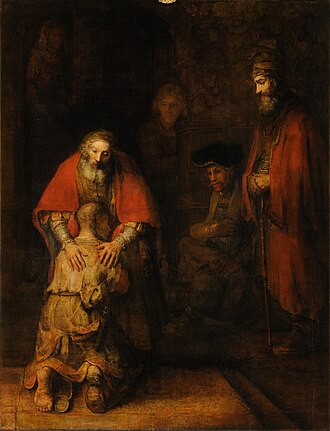 Die Rückkehr des verlorenen Sohnes - Rembrandt van Rijn (1668)
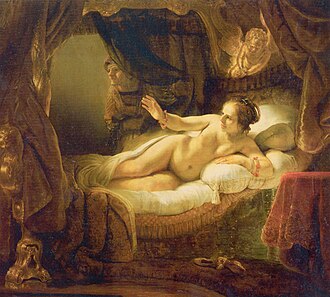 Danaë - Rembrandt van Rijn (1636)
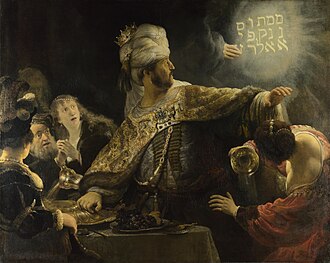 Das Gastmahl des Belsazar - Rembrandt van Rijn (1636)
Werke verwandter Künstler
 Das Mädchen mit dem Perlenohrgehänge - Johannes Vermeer (1665)
 Dienstmagd mit Milchkrug - Johannes Vermeer (c. 1658)
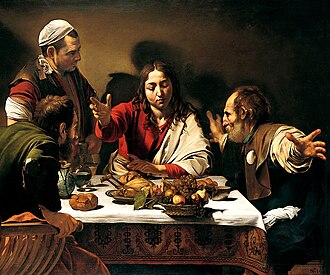 Das Abendmahl in Emmaus - Caravaggio (1601)
 Die Berufung des Hl. Matthäus - Caravaggio (1609)
 Las Meninas - Diego Velázquez (1656)
 Die Übergabe von Breda - Diego Velázquez (1635)