Zigeunerlager mit Pferdewagen
Vincent van Gogh · 1888
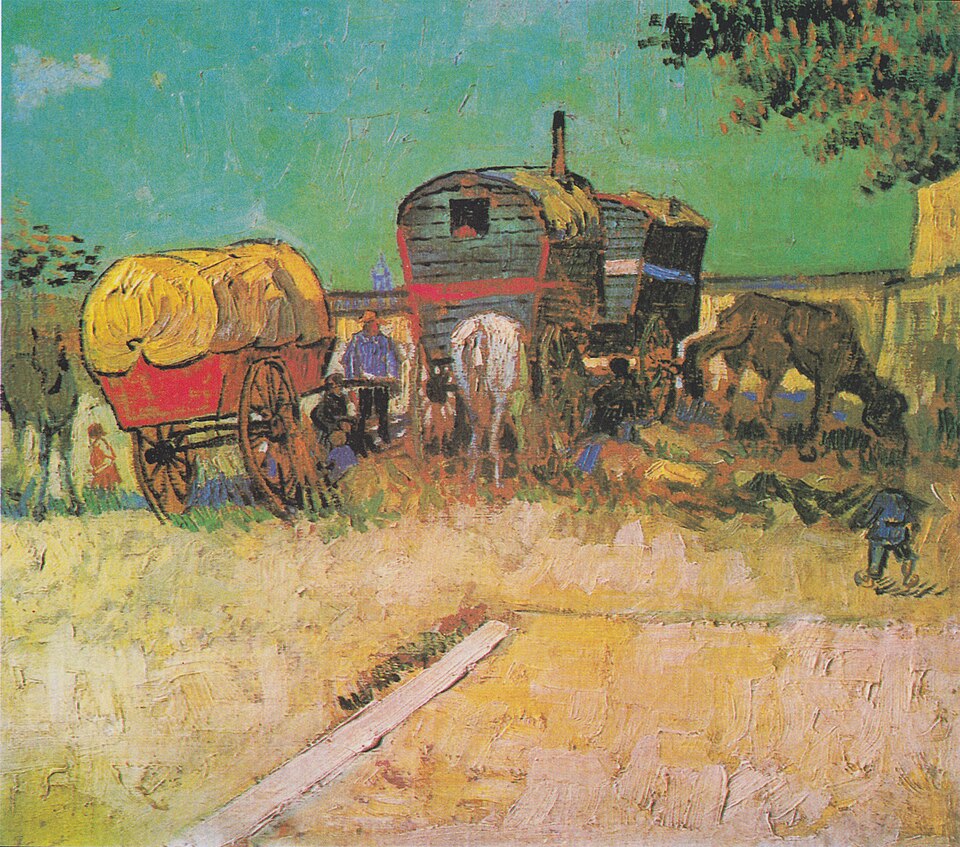
Two painted caravans, a covered cart, horses and a family resting in the Provençal countryside. Van Gogh, himself an outsider in Arles, stopped to paint people who lived on the move.
The story behind the painting
Van Gogh left Paris and settled in Arles in February 1888, captivated by the southern light. In August 1888, not far from Arles near Montmajour Abbey, he painted this small canvas, 45 by 51 cm, of a travellers' camp. To do it, he made friends with the Romani family so that he could show his own vision of their encampment. In Arles he painted some of his most famous canvases, among them The Sunflowers, the third Bedroom in Arles and L'Arlésienne.
What to look for
Look for two verdines, the wooden caravans used by Romani travellers from the mid 19th to the mid 20th century, and a covered cart, with two adults, three children and horses, almost certainly draught animals. An unseen arc runs from the rump of the left horse to the lowered head of the brown horse on the right, rising over the roof of the central caravan. The picture falls into three bands: sky, the group of caravans, people and animals, and the ground. The ground takes up most of the canvas and, surprisingly, is brighter than the sky.
Meaning and intent
Van Gogh was drawn to what he saw as a romantic and exotic way of life. The painting sets a perhaps freer nomadic community against his own isolation, even exclusion, in a more conservative Arles. His empathy for people on the margins was sharpened here by the wandering life he himself led in order to paint. Such halts of travelling families were common in the region at the time, and Van Gogh treats this one with warmth and care rather than distance.
Legacy
The painting passed from Maurice Fabre to the Galerie Druet and Paul Rosenberg, then to Raymond Koechlin and his wife from 1909 to 1931. In 1931 the State accepted it as a bequest to the Louvre, where it later hung at the Jeu de Paume, and in 1986 it went to the Musée d'Orsay, home also to his Bedroom in Arles and L'Arlésienne. A 2019 children's novel, Kalia sous les étoiles, reproduces it at the end.
Schon gewusst?
- Painted in August 1888 near Montmajour Abbey, close to Arles.
- Shows two caravans, a cart, two adults, three children and horses.
- The ground is brighter than the sky.
- At the Musée d'Orsay since 1986.
Über den Künstler
Vincent van Gogh (1853-1890)
Landschaftsmalerei · Musée d’Orsay · Hauspferd · Laubbaum
Mehr von Vincent van Gogh
 Die Sternennacht - Vincent van Gogh (1889)
 Caféterrasse am Abend - Vincent van Gogh (1888)
 Sonnenblumen - Vincent van Gogh (1888)
 Mandelblüte - Vincent van Gogh (1890)
 Weizenfeld mit Raben - Vincent van Gogh (1890)
 Das Schlafzimmer - Vincent van Gogh (1888)
 Die Kartoffelesser - Vincent van Gogh (1885)
 Schwertlilien - Vincent van Gogh (1889)
Werke verwandter Künstler
 Die großen Badenden - Paul Cézanne (1900s)
 Der Knabe mit der roten Weste - Paul Cézanne
 Woher kommen wir? Wer sind wir? Wohin gehen wir? - Paul Gauguin (1897-1898)
 Der gelbe Christus - Paul Gauguin (1889)
 Die Aufrichtung des Kreuzes - Peter Paul Rubens (1609)
 Der Raub der Töchter des Leukippos - Peter Paul Rubens (1618)
 Strandspaziergang - Joaquín Sorolla (1909)
 Sad Inheritance - Joaquín Sorolla (1898)
 Tanz im Moulin de la Galette - Pierre-Auguste Renoir (1876)
 Das Frühstück der Ruderer - Pierre-Auguste Renoir (1881)
 Das Promenoir des »Moulin Rouge« - Henri de Toulouse-Lautrec (1892)
 Die Toilette - Henri de Toulouse-Lautrec (1896)