Krebs, auf dem Rücken liegend
Vincent van Gogh · 1887
.jpg)
A single crab lies helpless on its back, legs in the air, against a field of green. Van Gogh turned one of the humblest things on a kitchen table into a small drama of colour and vulnerability.
The story behind the painting
Crab on its Back is an oil painting by Vincent van Gogh, a still life showing exactly what its title promises: a crab, overturned, set against a green background. Its date is not settled. The Van Gogh Museum in Amsterdam, which owns the work, places it in August-September 1887, when Van Gogh was living in Paris. Other sources date it to early 1889, after his move to the south of France. That gap matters, because the two dates belong to very different chapters of his life: the Paris years of learning from new art around him, and the intense, troubled period in Arles. The surviving sources do not tell us the day-to-day story of how this canvas was made, so the painting itself must do much of the talking.
What to look for
Stand back first and notice how little there is: one creature and one colour field. The crab lies upside down, its underside and jointed legs turned toward us rather than the armoured shell we usually see. The green background does not describe a table or a room; it simply surrounds the animal, pushing it forward. Green and the reddish tones of a crab sit opposite each other on the colour wheel, and Van Gogh was deeply interested in such contrasting pairs, so let your eye move between the creature and its setting and feel how each sharpens the other. Then come closer and follow the legs and claws one by one, the most intricate part of an otherwise spare picture. The canvas is modest, about 38 by 47 centimetres, an intimate size for an intimate subject.
Meaning and intent
A crab on its back is an image of helplessness: an animal built for defence, turned so that its armour is useless. Viewers often read this as a mirror of the painter's own fragility, though the sources do not record Van Gogh explaining the picture, so any such reading remains interpretation. What is documented is a possible artistic spark. The painting may have been inspired by a Japanese print of a crab by Hokusai that Van Gogh saw in the magazine Le Japon Artistique, which his brother Theo sent him in September 1888. If that link is right, it fits the later of the two proposed dates and connects the canvas to Van Gogh's deep admiration for Japanese art, with its love of single, closely observed natural forms.
Legacy
Today Crab on its Back belongs to the permanent collection of the Van Gogh Museum in Amsterdam, where it sits among the paintings that trace the artist's whole career. It has a close relative elsewhere: Van Gogh also painted Two Crabs in 1889, a still life with two crabs, one of them also lying on its back, now on display at the National Gallery in London. Seen together in the imagination, the two pictures show Van Gogh returning to the same unlikely subject. The small crab reminds us that his genius was not only for sunflowers and starry skies. He could find urgency, colour and feeling in a creature most people would simply have eaten.
Schon gewusst?
- The Van Gogh Museum dates the painting to August-September 1887, while other sources place it in early 1889.
- It may have been inspired by a Hokusai print of a crab reproduced in the magazine Le Japon Artistique.
- Theo van Gogh sent that magazine to Vincent in September 1888.
- A companion work, Two Crabs (1889), hangs in the National Gallery, London.
Über den Künstler
Vincent van Gogh (1853-1890)
Mehr von Vincent van Gogh
 Die Sternennacht - Vincent van Gogh (1889)
.jpg) Caféterrasse am Abend - Vincent van Gogh (1888)
Caféterrasse am Abend - Vincent van Gogh (1888) Sonnenblumen - Vincent van Gogh (1888)
 Mandelblüte - Vincent van Gogh (1890)
 Weizenfeld mit Raben - Vincent van Gogh (1890)
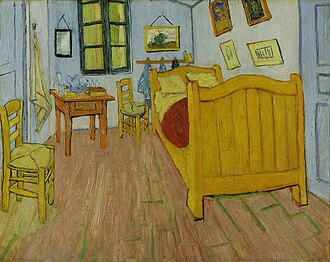 Das Schlafzimmer - Vincent van Gogh (1888)
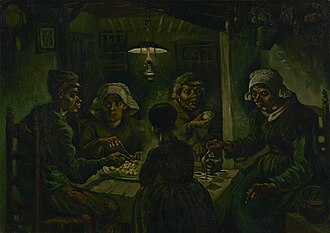 Die Kartoffelesser - Vincent van Gogh (1885)
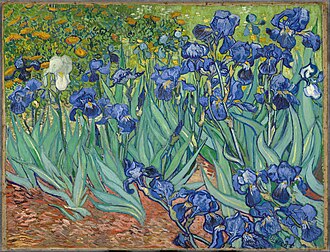 Schwertlilien - Vincent van Gogh (1889)
Werke verwandter Künstler
 Woher kommen wir? Wer sind wir? Wohin gehen wir? - Paul Gauguin (1897-1898)
%201889.jpg) Der gelbe Christus - Paul Gauguin (1889)
Der gelbe Christus - Paul Gauguin (1889) Das Frühstück im Grünen - Édouard Manet (1863)
 Olympia - Édouard Manet (1863)