Christus am Ölberg
Paul Gauguin · 1889
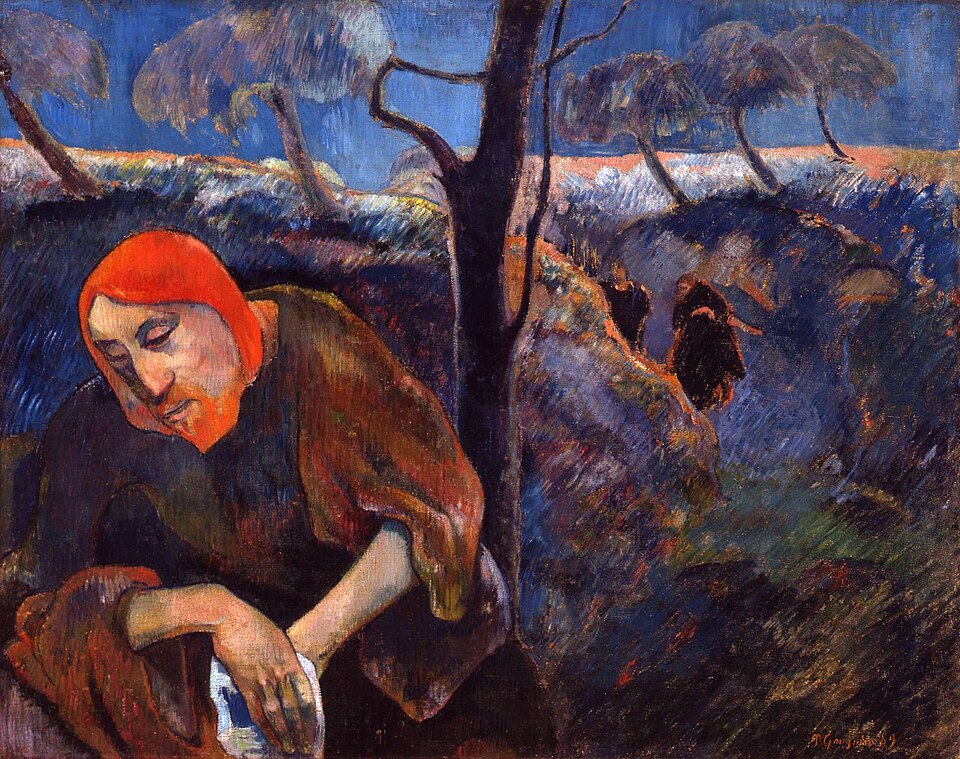
Head bowed, face full of sorrow, Christ waits in a dark garden for the soldiers. The face is Gauguin's own, painted in Brittany in 1889 after his failures in Paris.
The story behind the painting
Gauguin painted this picture at Le Pouldu in Brittany in November 1889, when he was emotionally distraught after recent failures in Paris exhibitions. In a letter to Emile Schuffenecker he wrote that the news from Paris discouraged him so much that he lacked the courage to paint, and that he dragged his old body along the shore at Le Pouldu in the north wind. His soul, he wrote, was far away, looking sadly into a black abyss opening before him. The painting is both a self-portrait and an image of Jesus about to be taken by the soldiers.
What to look for
The central figure, with Gauguin's features, bows his head towards the ground, his face full of sorrow and despair. Two smaller figures trail behind him, creating depth and a sense of hierarchy, and Gauguin left them without faces so they would not draw attention from the main figure. Each brushstroke builds a hazy texture, so the scene almost looks like a vision. The central figure is built in warm colours, while the outdoor landscape behind is made almost entirely of cool ones, a contrast that balances the whole canvas, about 72 by 91 cm.
Meaning and intent
In 1891 the critic Jules Huret asked Gauguin about the work. He answered that it was meant to symbolise the failure of an ideal, a suffering both divine and human, Jesus abandoned by all his disciples, his surroundings as sad as his soul. Gauguin had unusual religious ideas and was drawn to Theosophy, and he used the relationship between Christ and the world as a metaphor for his own relationship with art. Placing himself in Christ's position, he likened his rejection to the Saviour's, as someone who would suffer for the sake of others.
Legacy
The same year Gauguin painted Self-Portrait with Halo and Snake, another image in which he gave himself a sacred role. The scholar Wladyslawa Jaworska wrote that alongside his bitter feeling that nobody understood him grew his conviction that he was the chosen one and the redeemer of modern painting. Gauguin believed artists should work from imagination and memory rather than reference images, a key difference from post-impressionists such as Vincent van Gogh. His work went on to influence the Symbolist movement and modern art. The painting is now in the Norton Museum of Art.
Schon gewusst?
- Painted at Le Pouldu, Brittany, in November 1889.
- Both a self-portrait and Christ before his arrest.
- Gauguin explained it to Jules Huret in 1891.
- Now in the Norton Museum of Art.
Über den Künstler
Paul Gauguin (1848-1903)
Mehr von Paul Gauguin
 Woher kommen wir? Wer sind wir? Wohin gehen wir? - Paul Gauguin (1897-1898)
 Der gelbe Christus - Paul Gauguin (1889)
 Nafea faa ipoipo - Paul Gauguin (1892)
 Frauen aus Tahiti - Paul Gauguin (1890)
 Vision nach der Predigt - Paul Gauguin (1888)
Manaò tupapaú - Paul Gauguin (1892)
 Porträt des Vincent van Gogh, Sonnenblumen malend - Paul Gauguin (1888)
 Gegrüßt seist du, Maria - Paul Gauguin (1891)
Werke verwandter Künstler
 Die Sternennacht - Vincent van Gogh (1889)
 Caféterrasse am Abend - Vincent van Gogh (1888)
 Strandspaziergang - Joaquín Sorolla (1909)
 Sad Inheritance - Joaquín Sorolla (1898)
 Die großen Badenden - Paul Cézanne (1900s)
 Der Knabe mit der roten Weste - Paul Cézanne
 Tanz im Moulin de la Galette - Pierre-Auguste Renoir (1876)
 Das Frühstück der Ruderer - Pierre-Auguste Renoir (1881)
 Das Promenoir des »Moulin Rouge« - Henri de Toulouse-Lautrec (1892)
 Die Toilette - Henri de Toulouse-Lautrec (1896)