Catalonia. The fish
Joaquín Sorolla · 1915
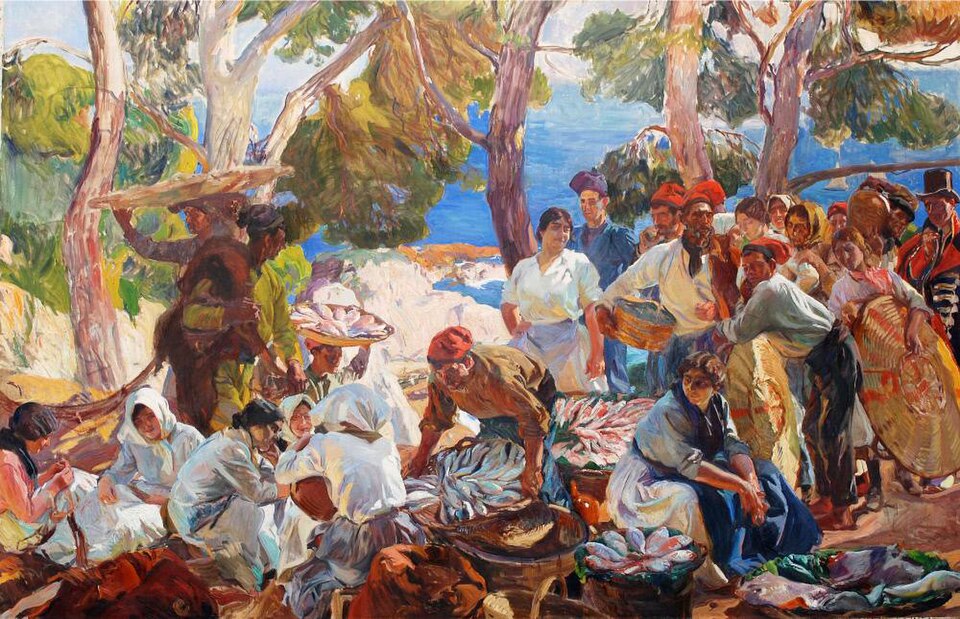
A Barcelona fish market, carried as if by magic to a pine-ringed cove on the Costa Brava. Sorolla searched the Catalan coast for weeks before he found the place, then painted a panel nearly five metres wide.
The story behind the painting
The American Hispanist Archer Milton Huntington commissioned large paintings to decorate the library of the Hispanic Society of America in New York. From 1911 Sorolla travelled alone across Spain for six years for this series, Vision of Spain, fourteen panels considered his masterpiece. For Catalonia he settled in Barcelona on 15 September 1915. He loved the port but rejected it as a setting, and the artists Carlos Vázquez, Anglada Camarasa and Santiago Rusiñol showed him Arenys de Mar, Tarragona and Sitges. Vázquez finally led him to the beach of Santa Cristina in Lloret de Mar. Even then he doubted, writing that the people lacked picturesque character.
What to look for
Pines ring the cove of Santa Cristina in the background. In front, a fish market of the Barceloneta neighbourhood, still very active in 1915, fills the beach in a symbolic scene of fishing and selling the catch. The curator Felipe Garín sees clear echoes of Cézanne in the way the pines are painted. Look for Sorolla's typical white and mauve axis, here stronger than before: the white runs in a broken line through the women's clothes, from the left to the shirt of the woman at the centre. Sources give the size as 4.85 by 3.51 metres, and the landscape study was only about 0.70 by 1 metre.
Meaning and intent
Sorolla doubted where to place this tenth panel more than any other. At first the subject was to be the port of Barcelona; later he chose to put the fish first, but moved the setting north to Santa Cristina, the site of a procession every 24 July. On 30 September 1915 he wrote to his family that Santa Cristina was a marvel, with great pines over the mountain, light-coloured rocks and a wonderful blue and green sea, something Greek. The painting joins a real Barcelona market to an ideal Catalan landscape, a portrait of a region rather than of a single place.
Legacy
In mid-November 1915 poor health sent Sorolla back to Madrid, and he finished the mural in December. For years many historians placed the scene somewhere vague on the Catalan coast. In 1992 Sebastià Ruscalleda identified the cove of Santa Cristina, after Sorolla's great-granddaughter Blanca Pons Sorolla read him a letter the painter had sent his wife Clotilde García del Castillo describing it. He published the discovery in 1993 as Sorolla en Santa Cristina. The panel remains at the Hispanic Society of America in New York, where the whole series was meant to hang.
Schon gewusst?
- Painted in 1915 for the Hispanic Society of America in New York.
- One of the fourteen panels of Sorolla's Vision of Spain.
- Shows a Barceloneta fish market set in the cove of Santa Cristina, Lloret de Mar.
- The location was identified by Sebastià Ruscalleda in 1992.
Über den Künstler
Joaquín Sorolla (1863-1923)
Mehr von Joaquín Sorolla
 Strandspaziergang - Joaquín Sorolla (1909)
 Sad Inheritance - Joaquín Sorolla (1898)
 Kinder am Strand - Joaquín Sorolla (1910)
 White slave trade - Joaquín Sorolla (1894)
 And They Still Say Fish is Expensive! - Joaquín Sorolla (1894)
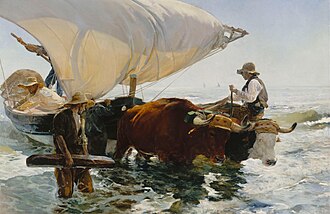 Die Heimkehr der Fischer - Joaquín Sorolla (1894)
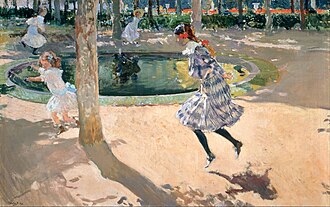 Seilspringen. La Granja - Joaquín Sorolla (1911)
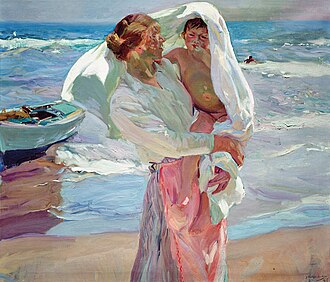 After Bathing - Joaquín Sorolla (1915)
Werke verwandter Künstler
 Die Sternennacht - Vincent van Gogh (1889)
 Caféterrasse am Abend - Vincent van Gogh (1888)
 Woher kommen wir? Wer sind wir? Wohin gehen wir? - Paul Gauguin (1897-1898)
 Der gelbe Christus - Paul Gauguin (1889)
 Die großen Badenden - Paul Cézanne (1900s)
 Der Knabe mit der roten Weste - Paul Cézanne
 Tanz im Moulin de la Galette - Pierre-Auguste Renoir (1876)
 Das Frühstück der Ruderer - Pierre-Auguste Renoir (1881)
 Das Promenoir des »Moulin Rouge« - Henri de Toulouse-Lautrec (1892)
 Die Toilette - Henri de Toulouse-Lautrec (1896)