Tulpenfelder
Vincent van Gogh · 1883
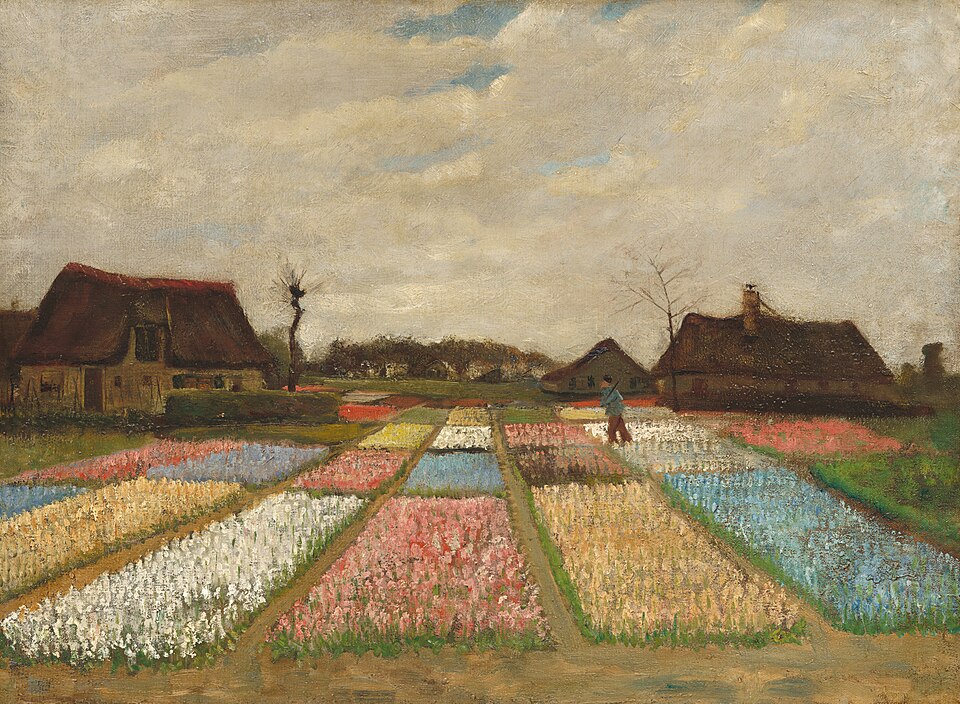
Before the sunflowers, before Provence, there was this: a young Van Gogh crouching low in a Dutch spring, watching stripes of hyacinths run toward the horizon like ribbons of colour.
The story behind the painting
Bulb Fields, also known as Flower Beds in Holland, was painted in early 1883, during Vincent van Gogh's second year in The Hague. He was still a young artist teaching himself his craft, years before the blazing canvases of the south of France. This was his first garden painting, made in oil on canvas mounted on wood. The subject was a thoroughly Dutch one: the plots of hyacinths grown by a bulb merchant, laid out in neat rectangles of colour. For a painter learning his trade, such a field offered something precious, a ready-made lesson in order, space and colour, waiting outdoors under the spring sky.
What to look for
Notice first how low you stand. Van Gogh chose a low vantage point, so the field opens out before you as a broad panorama, its beds stretching away in bands of blue, yellow, pink and red. These are hyacinths, set out in rectangular plots, and their regular rows pull the eye steadily back into depth. That geometry was the point: the orderly composition let Van Gogh explore his interest in perspective. Beyond the flowers, look for the thatched cottages and the leafless trees in the background, a reminder that this is early spring, when blossoms arrive before the branches have filled with leaves.
Meaning and intent
This is not yet the visionary Van Gogh of swirling skies, and that is exactly what makes it moving. Here we meet an artist at work on fundamentals, using a commercial flower field as a drawing exercise in perspective and as a first encounter with colour laid out in pure blocks. The painting is catalogued as realism, and its honesty is plain: working land, a merchant's crop, modest rural houses. Yet the brilliant stripes of hyacinths hint at the joy in colour that would later define him. In this early, careful canvas, the seed of the future painter is already quietly sprouting.
Legacy
The painting's own journey reads like a small adventure. Van Gogh seems to have left it with other early works at his family's home in Nuenen in 1885; it then travelled with his widowed mother and sister to Breda. Stored with other belongings by a carpenter, it was sold in 1902 among so-called worthless rubbish to a merchant, then exhibited in Rotterdam that same year as Tulip Country, though the flowers are hyacinths. After passing through several owners and dealers, it was acquired by Paul Mellon in 1955 and donated to the National Gallery of Art in Washington in 1983, where it can be seen today.
Schon gewusst?
- It was Van Gogh's first garden painting, made in 1883 in The Hague.
- The flowers are hyacinths, although it was once exhibited under the title Tulip Country.
- In 1902 it was sold along with belongings described as worthless rubbish.
- Paul Mellon gave it to the National Gallery of Art, Washington, in 1983.
Über den Künstler
Vincent van Gogh (1853-1890)
Landschaftsmalerei · Baum · National Gallery of Art · Haus · Acker
Mehr von Vincent van Gogh
 Die Sternennacht - Vincent van Gogh (1889)
.jpg) Caféterrasse am Abend - Vincent van Gogh (1888)
Caféterrasse am Abend - Vincent van Gogh (1888) Sonnenblumen - Vincent van Gogh (1888)
 Mandelblüte - Vincent van Gogh (1890)
 Weizenfeld mit Raben - Vincent van Gogh (1890)
 Das Schlafzimmer - Vincent van Gogh (1888)
 Die Kartoffelesser - Vincent van Gogh (1885)
 Schwertlilien - Vincent van Gogh (1889)
Werke verwandter Künstler
 Woher kommen wir? Wer sind wir? Wohin gehen wir? - Paul Gauguin (1897-1898)
%201889.jpg) Der gelbe Christus - Paul Gauguin (1889)
Der gelbe Christus - Paul Gauguin (1889) Das Frühstück im Grünen - Édouard Manet (1863)
 Olympia - Édouard Manet (1863)