Balaams Esel
Rembrandt van Rijn · 1626
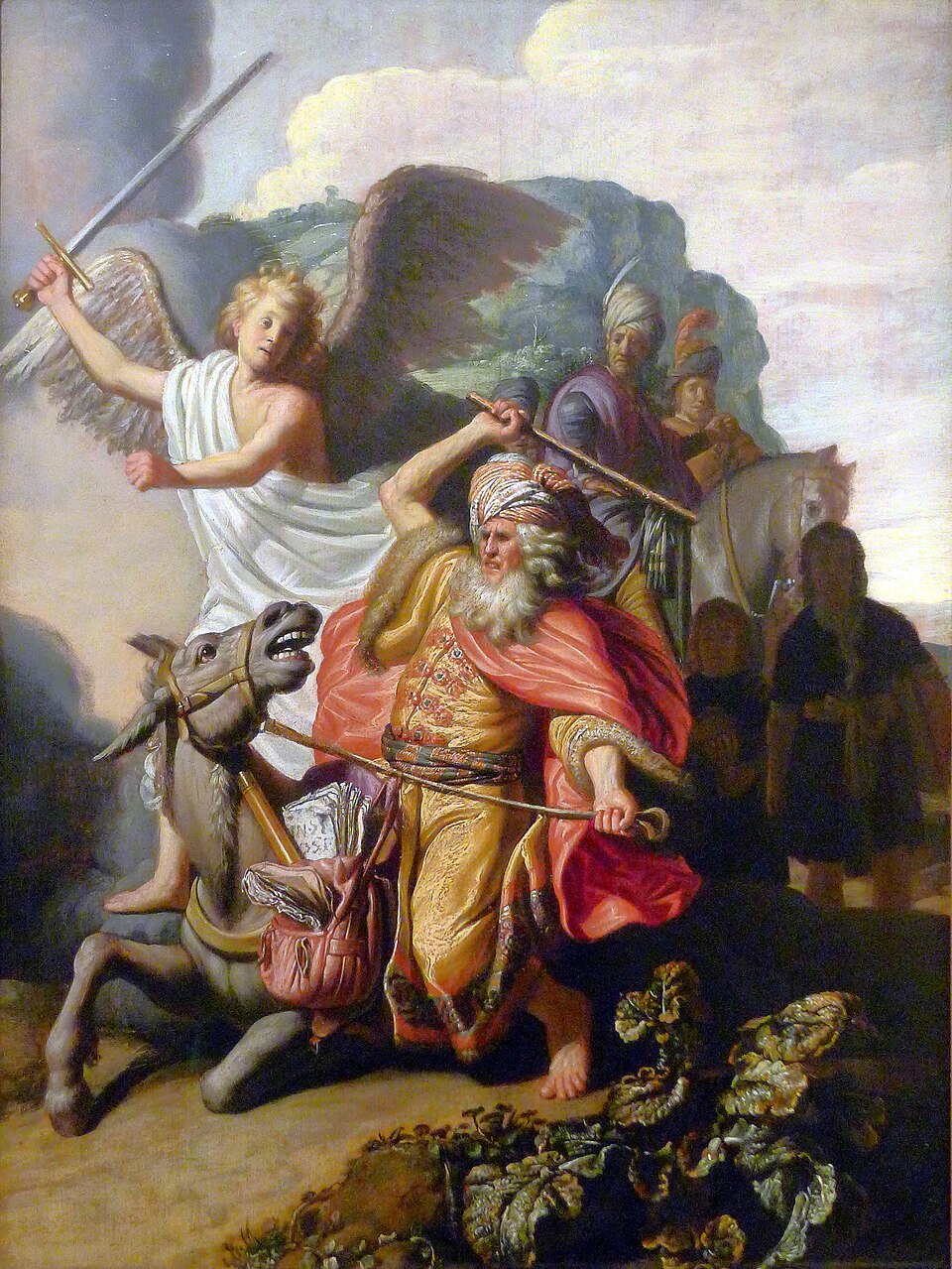
A prophet raises his stick, a donkey turns to answer back, and an angel stands where only the animal can see. In 1626 the young Rembrandt took on one of the Bible's strangest arguments.
The story behind the painting
Rembrandt painted Balaam and the Ass in 1626, during his years in Leiden. Only a year earlier he had opened a studio there, which he shared with his friend and colleague Jan Lievens. Before that he had studied for three years with Jacob van Swanenburg and then spent a brief but important six months in Amsterdam with the history painter Pieter Lastman. That short apprenticeship shaped this picture directly. In 1622 Lastman had painted the very same subject, and the young Rembrandt built his scene on his teacher's composition. The figure of Balaam and the figure of his ass are direct borrowings from Lastman. Here, then, is a gifted beginner learning in public, taking a master's design and testing what he could do with it.
What to look for
The panel is modest in size, about 63 by 46.5 centimetres, so step close. The story it tells is the biblical account in which Balaam's donkey speaks and argues with its rider. Find the three players listed in the painting's record: the prophet Balaam, his ass, and the angel. Notice how the man and the animal are locked together in a single knot of argument, the figures Rembrandt took over from Lastman. Then look for the angel, the presence that sets the whole quarrel in motion. Rembrandt's early works are described as small but rich in details, such as costumes and jewellery, so let your eye wander slowly over the surface.
Meaning and intent
The subject is a story about seeing. In the biblical account the diviner Balaam argues with the ass that has stopped beneath him, and the angel among the painting's subjects is the reason the animal will not go on. A humble beast debating a learned man makes a pointed, almost comic reversal, and religious subjects like this dominated Rembrandt's early output. The painting also carries a second, quieter meaning about learning itself. By borrowing Lastman's Balaam and ass so openly, Rembrandt shows how a young painter of his time absorbed a teacher's lessons: not by inventing from nothing, but by entering a known composition and making it his own.
Legacy
Balaam and the Ass belongs to the first chapter of a long career. In late 1631 Rembrandt left Leiden for Amsterdam, then a fast-growing capital of business and trade, and his most prosperous years as a portraitist began. Pictures like this one let us see where that journey started, still close to Lastman. Lastman's own version of 1622 is today in the Israel Museum Collection in Jerusalem, so the teacher's and the pupil's paintings can be compared, if only across a distance. Wikidata records that the panel once passed through the Jacques Goudstikker collection. Today it hangs in Paris, in the Musée Cognacq-Jay.
Schon gewusst?
- Painted in 1626, during Rembrandt's Leiden period (Wikipedia)
- Based on Pieter Lastman's 1622 composition, now in the Israel Museum, Jerusalem (Wikipedia)
- Size about 63 × 46.5 cm (Wikidata)
- Held by the Musée Cognacq-Jay, Paris (Wikipedia)
Wikipedia · Wikipedia (Rembrandt) · Wikidata
Über den Künstler
Rembrandt van Rijn (1606-1669)
religiöse Kunst · Niederländisches Goldenes Zeitalter der Malerei · Engel
Mehr von Rembrandt van Rijn
 Die Nachtwache - Rembrandt van Rijn (1642)
 Selbstbildnis - Rembrandt van Rijn (1659)
 Die Anatomie des Dr. Tulp - Rembrandt van Rijn (1632)
 Die Judenbraut - Rembrandt van Rijn (1660s)
 Der Sturm auf dem See Genesareth - Rembrandt van Rijn (1633)
 Die Rückkehr des verlorenen Sohnes - Rembrandt van Rijn (1668)
 Danaë - Rembrandt van Rijn (1636)
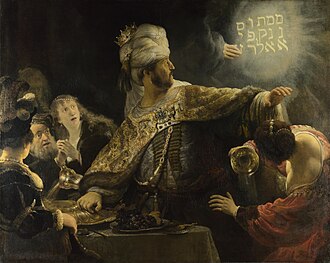 Das Gastmahl des Belsazar - Rembrandt van Rijn (1636)
Werke verwandter Künstler
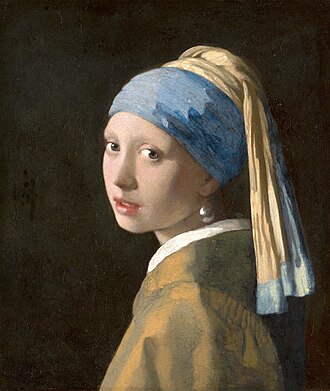 Das Mädchen mit dem Perlenohrgehänge - Johannes Vermeer (1665)
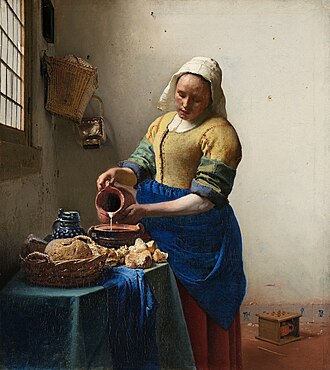 Dienstmagd mit Milchkrug - Johannes Vermeer (c. 1658)
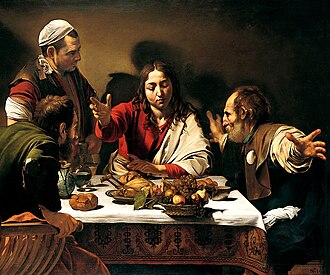 Das Abendmahl in Emmaus - Caravaggio (1601)
 Die Berufung des Hl. Matthäus - Caravaggio (1609)
 Las Meninas - Diego Velázquez (1656)
 Die Übergabe von Breda - Diego Velázquez (1635)