Artist in his studio
Rembrandt van Rijn · 1628
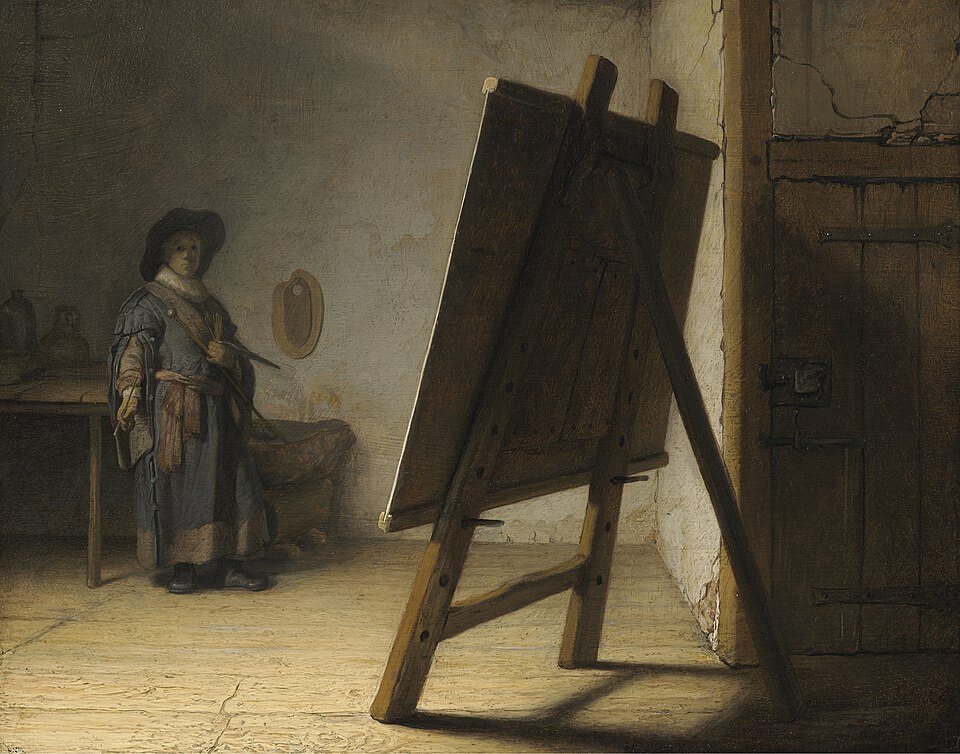
A small figure in a long robe stands far back from a huge easel, brush in hand, just looking. Rembrandt painted not the act of painting but the moment before it, when the picture exists only in the artist's mind.
The story behind the painting
The Artist in his Studio is a small oil on panel by Rembrandt from his early years in Leiden. Wikipedia dates it to 1629, while Wikidata gives 1628. It is unsigned, but historians are confident it is his: the semi-transparent browns and greys of the shadows match his Munich Self-Portrait of 1629, he outlines forms in dark paint as in Supper at Emmaus, and the thickly painted robe resembles the old man's garment in the Turin Old Man Asleep by the Fire.
What to look for
The painter stands on the left in a tabard, holding a palette, brushes and a maulstick in his left hand and a single brush in his right. He stands, though artists of the time usually sat to paint, and he is far from the easel, which fills the foreground with its back to us. The room is almost empty: a table with two bottles, two palettes on the wall, a grinding stone for preparing paint. Light cuts diagonally from the upper left. The panel measures about 24.8 by 31.7 cm.
Meaning and intent
Because we cannot see the picture on the easel, we cannot tell whether it is finished or even begun. In the seventeenth century there was an idea that an artist had to envision a work fully in his mind before starting, and Rembrandt may be showing exactly that. Wear on the easel's crossbar suggests the painter usually sits with his feet resting there, which makes his standing distance more striking. The bare studio keeps our attention on the man and the space between him and his work.
Legacy
Who is the painter? Some scholars think it is Rembrandt's pupil Gerrit Dou, who was fourteen when he joined him, citing the figure's childlike stature. Others say the figure is of normal adult height once perspective is taken into account, and that the eyebrows match Rembrandt's own self-portraits. The studio itself, on an upper floor of a Dutch townhouse, is probably Rembrandt's. The painting is now in the Museum of Fine Arts, Boston.
Schon gewusst?
- Painted around 1628-1629; the sources differ by a year.
- Unsigned, but attributed to Rembrandt on style and technique.
- The painter may be Rembrandt himself or his pupil Gerrit Dou.
- In the Museum of Fine Arts, Boston.
Über den Künstler
Rembrandt van Rijn (1606-1669)
Genreszene · Niederländisches Goldenes Zeitalter der Malerei · Museum of Fine Arts Boston · Maler · Tür · Staffelei · Künstler · Pinsel · Farbpalette
Mehr von Rembrandt van Rijn
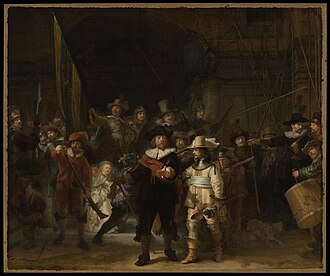 Die Nachtwache - Rembrandt van Rijn (1642)
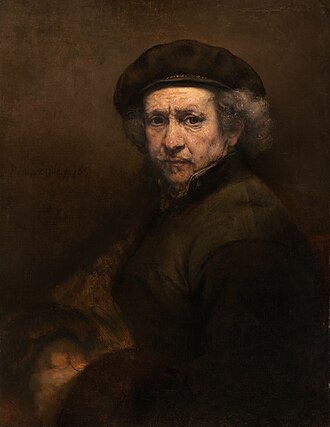 Selbstbildnis - Rembrandt van Rijn (1659)
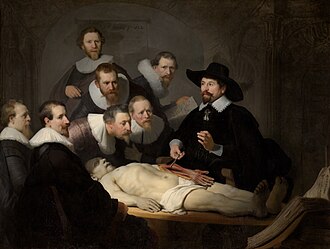 Die Anatomie des Dr. Tulp - Rembrandt van Rijn (1632)
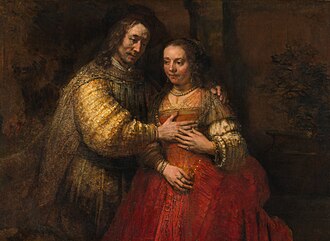 Die Judenbraut - Rembrandt van Rijn (1660s)
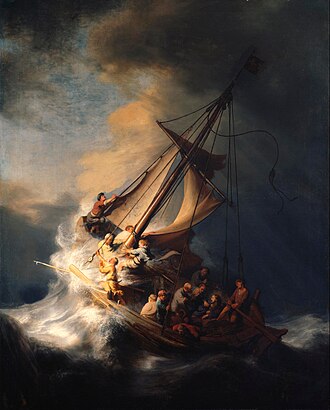 Der Sturm auf dem See Genesareth - Rembrandt van Rijn (1633)
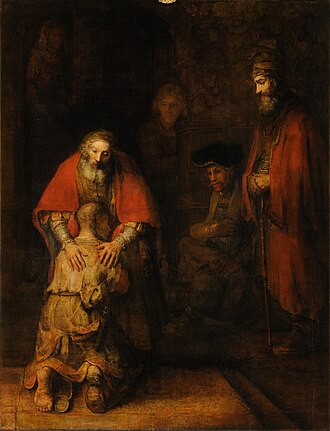 Die Rückkehr des verlorenen Sohnes - Rembrandt van Rijn (1668)
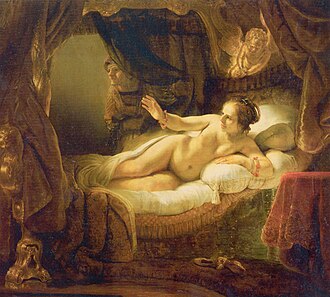 Danaë - Rembrandt van Rijn (1636)
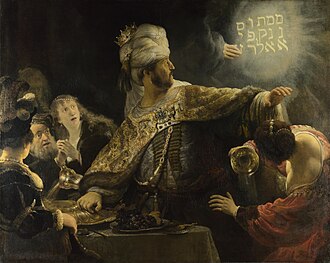 Das Gastmahl des Belsazar - Rembrandt van Rijn (1636)
Werke verwandter Künstler
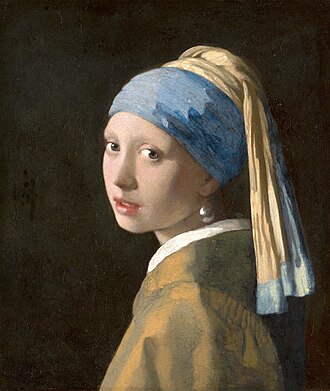 Das Mädchen mit dem Perlenohrgehänge - Johannes Vermeer (1665)
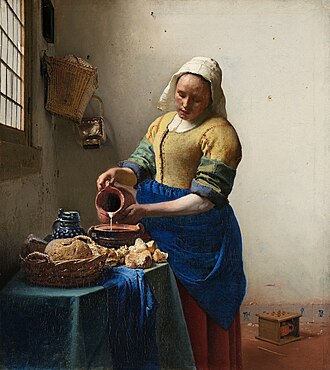 Dienstmagd mit Milchkrug - Johannes Vermeer (c. 1658)