Marokkaner beim Satteln seines Pferdes
Eugène Delacroix · 1855
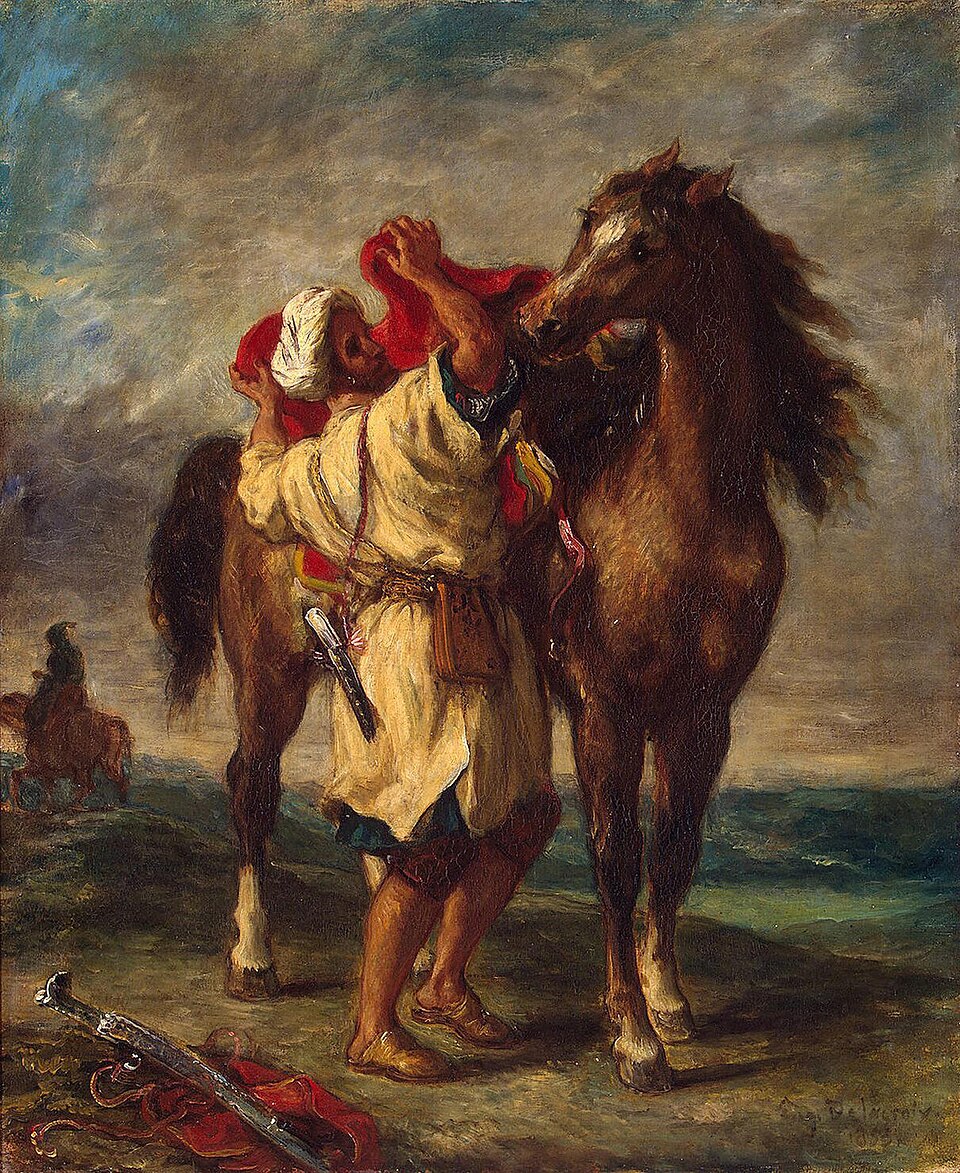
A man in a white turban throws a red blanket over his horse beneath a stormy sky. Delacroix painted the scene in 1855, but the idea had travelled with him for some thirty years.
The story behind the painting
The picture is signed and dated at lower right: Eug. Delacroix 1855. Its idea, however, probably goes back to the 1820s. In 1824 Delacroix made an aquatint with a very similar composition and subject, A Turk Saddling a Horse, of which one impression is in the Metropolitan Museum of Art in New York. The name of the man has changed with time too: the gallery catalogue of 1868 listed the painting as Turk Saddling a Horse, and the first scholarly catalogue of Delacroix's work, published in 1885, gave it its present title, A Moroccan Saddling His Horse.
What to look for
An adult Moroccan man, dressed in light clothing and a white turban, saddles his horse against a hilly landscape. On the ground beside him lies a sabre in a sheath on a sling. In the background on the left, the silhouette of a rider in a dark robe can be seen. The canvas measures about 56 by 47 cm according to Wikidata. Watch the colour: the man's short pale yellow robe is set against the red blanket he lifts onto the horse, while a blue sky with light and dark grey clouds hangs over dark green hills.
Meaning and intent
The picture is built on Delacroix's typical contrasts. The stormy mood of the sky clashes with the deep green of the distant hills, and the yellow of the robe answers the red of the blanket. Together these contrasts turn an apparently ordinary moment, a man preparing his horse, into a scene full of movement and expression. Wikidata places it within Orientalism, the European fascination with North Africa and the Middle East that ran through much of Delacroix's work.
Legacy
Almost as soon as it was finished, the painting was bought by Count Kushelev-Bezborodko. After his death in 1862 it passed by bequest, with his whole collection, to the Museum of the Academy of Arts in Saint Petersburg, where it formed part of the special Kushelev gallery. In 1922 it was transferred to the Hermitage, and since late 2014 it has hung in the General Staff Building, room 308, next to Delacroix's Lion Hunt in Morocco. In 1972 the Soviet post office issued a 20 kopeck stamp reproducing the painting.
Schon gewusst?
- Signed and dated Eug. Delacroix 1855.
- A similar aquatint, A Turk Saddling a Horse, dates from 1824.
- Bought by Count Kushelev-Bezborodko, then in the Hermitage since 1922.
- Reproduced on a Soviet postage stamp in 1972.
Über den Künstler
Eugène Delacroix (1798-1863)
Porträt · Mann · Eremitage · Himmel · Hauspferd · Reiten · Bart · ländlicher Raum · Turban
Mehr von Eugène Delacroix
 Die Freiheit führt das Volk - Eugène Delacroix (1830)
 Der Tod des Sardanapal - Eugène Delacroix (1827)
 Massaker von Chios - Eugène Delacroix (1824)
 Die Dantebarke - Eugène Delacroix (1822)
 Die Frauen von Algier - Eugène Delacroix (1834)
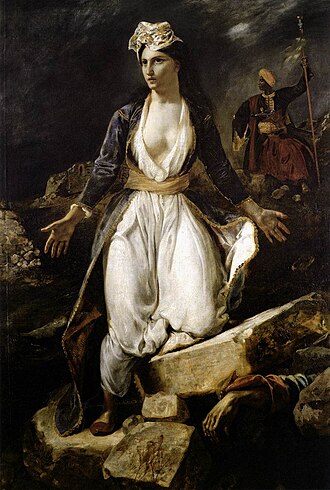 Griechenland auf den Ruinen von Mesolongi - Eugène Delacroix (1826)
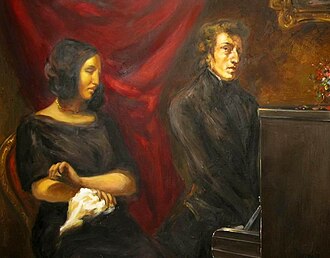 Portrait of Frédéric Chopin and George Sand - Eugène Delacroix (1837)
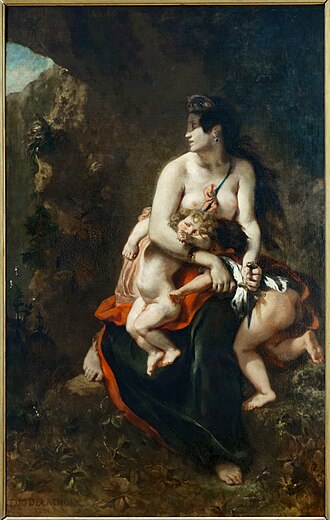 Medea - Eugène Delacroix (1836)
Werke verwandter Künstler
 Die Erschießung der Aufständischen - Francisco Goya (1814)
 Die nackte Maja - Francisco Goya (1800)
 Der Wanderer über dem Nebelmeer - Caspar David Friedrich (c. 1818)
 Abtei im Eichwald - Caspar David Friedrich (1800s)
 Die letzte Fahrt der Temeraire - J. M. W. Turner (1839)
 Rain, Steam and Speed - The Great Western Railway - J. M. W. Turner (1844)
 Knabe in Blau - Thomas Gainsborough (1770)
 Mr. und Mrs. Andrews - Thomas Gainsborough (1748)