Geschlachteter Ochse
Rembrandt van Rijn · 1655
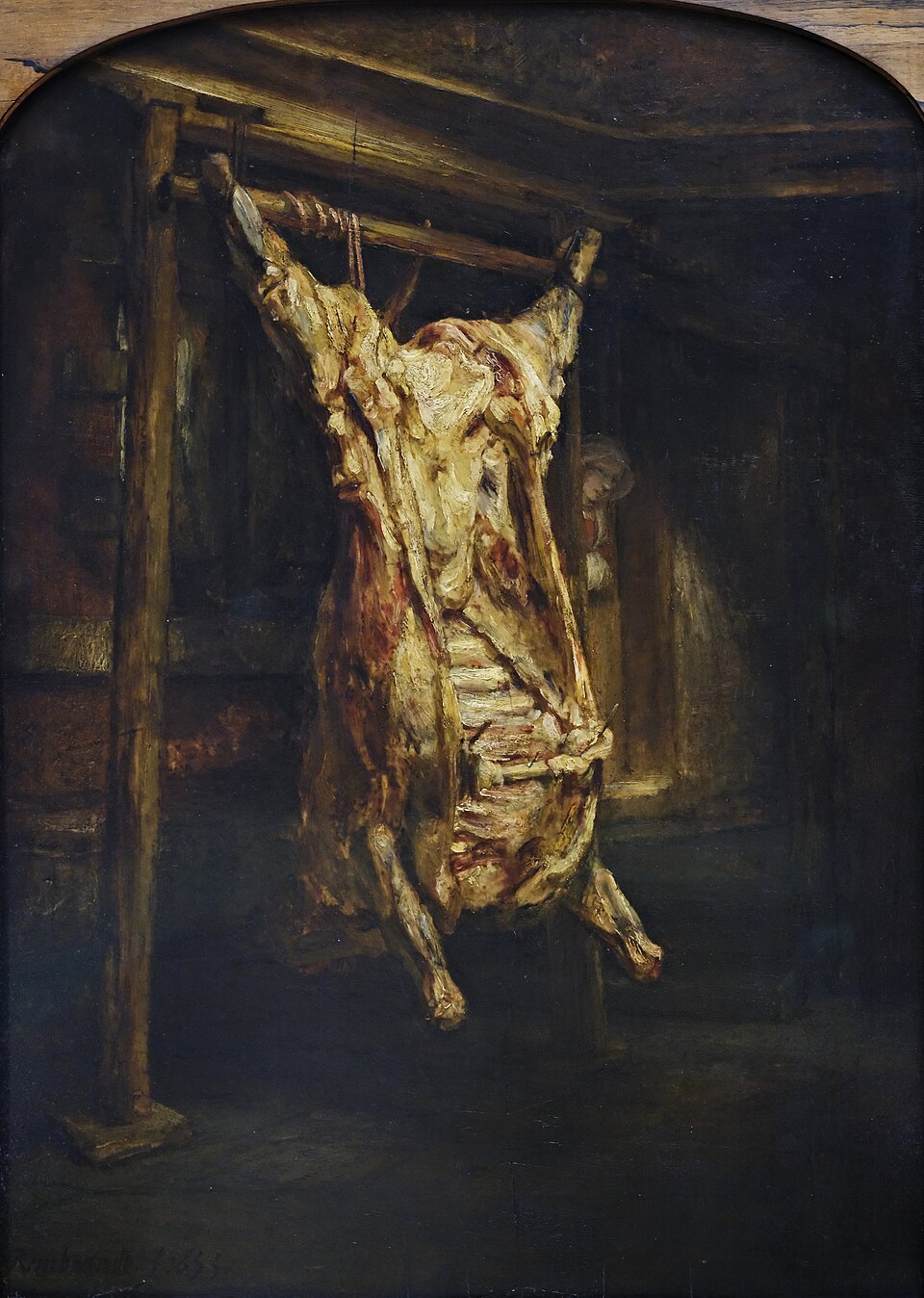
A flayed carcass hangs from a wooden beam, ribs spread open, glowing with thick paint. Behind a half-open door a woman looks out. Rembrandt turned a butcher's sight into one of the most haunting still lifes ever painted.
The story behind the painting
Slaughtered Ox, also known as Flayed Ox, Side of Beef or Carcass of Beef, is an oil on beech panel signed and dated Rembrandt f. 1655. It follows a tradition of butchery pictures, such as Pieter Aertsen's meat stall of 1551, Annibale Carracci's Butcher's Shop and especially Joachim Beuckelaer's Slaughtered Pig of 1563. Rembrandt had drawn a similar scene around 1635. In northern Europe, November was the traditional time to slaughter livestock, before winter made feed hard to find.
What to look for
The carcass of a bull or ox hangs in a wooden building, perhaps a stable or lean-to, suspended by its two hind legs, which are roped to a crossbeam. The head is gone, the skin and hair are removed, and the chest has been stretched open and emptied, showing flesh, fat, joints, bones and ribs. The colour is carefully built up, with thick impasto giving texture. In the background a woman peers from behind a half-open door, turning the still life into a scene of everyday life. Wikipedia gives 95.5 by 68.8 cm, Wikidata 94 by 69 cm.
Meaning and intent
The painting is sometimes read as a vanitas or memento mori, a reminder of death. Some commentators connect it with the fatted calf killed in the parable of the Prodigal Son, and others directly with the Crucifixion of Jesus. The small human presence of the woman beside the huge, opened body adds a quiet tension between ordinary household work and something far heavier. Whichever reading one prefers, the carcass is painted with careful colour and thick impasto, so the viewer looks at it far longer than at an ordinary market scene.
Legacy
The panel was possibly owned by Christoffel Hirschvogel in 1661. Joshua Reynolds saw it in the collection of Pieter Locquet in Amsterdam in 1781. It later belonged to Louis Viardot, who sold it to the Louvre in 1857. Similar pictures in Glasgow, Budapest and Philadelphia are thought to be by pupils or Rembrandt's circle. Its muscular painting inspired Honore Daumier, Eugene Delacroix, Chaim Soutine and Francis Bacon, whose Figure with Meat of 1954 places Velazquez's Pope Innocent X before what is likely a version of this carcass.
Schon gewusst?
- Signed and dated Rembrandt f. 1655, oil on beech panel.
- In the Louvre since 1857.
- Read as a vanitas or memento mori.
- Inspired Soutine and Francis Bacon.
Über den Künstler
Rembrandt van Rijn (1606-1669)
Gemäldeabteilung des Louvre · Niederländisches Goldenes Zeitalter der Malerei · Stillleben · Abhängen
Mehr von Rembrandt van Rijn
 Die Nachtwache - Rembrandt van Rijn (1642)
 Selbstbildnis - Rembrandt van Rijn (1659)
 Die Anatomie des Dr. Tulp - Rembrandt van Rijn (1632)
 Die Judenbraut - Rembrandt van Rijn (1660s)
 Der Sturm auf dem See Genesareth - Rembrandt van Rijn (1633)
 Die Rückkehr des verlorenen Sohnes - Rembrandt van Rijn (1668)
 Danaë - Rembrandt van Rijn (1636)
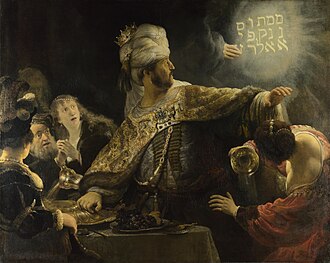 Das Gastmahl des Belsazar - Rembrandt van Rijn (1636)
Werke verwandter Künstler
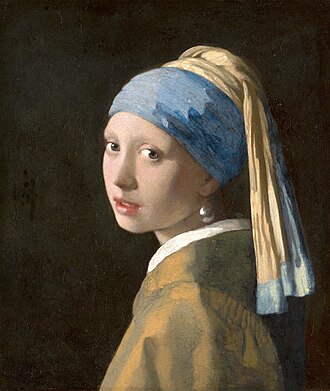 Das Mädchen mit dem Perlenohrgehänge - Johannes Vermeer (1665)
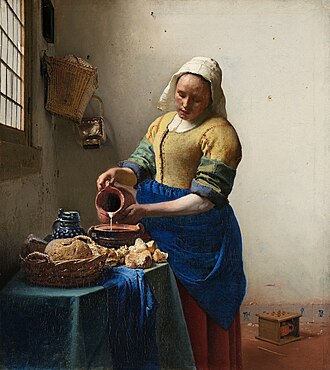 Dienstmagd mit Milchkrug - Johannes Vermeer (c. 1658)
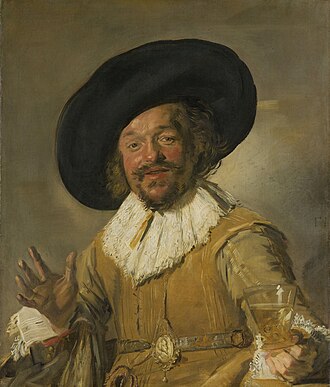 Ein Schütze einen Berkemeyer haltend, bekannt als „Der fröhliche Trinker" - Frans Hals (1620s)
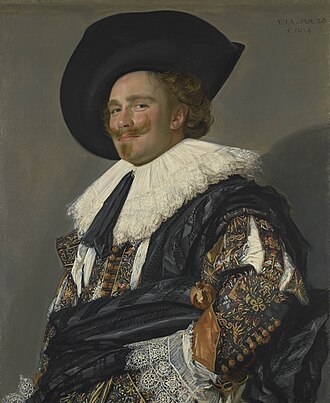 Der lachende Kavalier - Frans Hals (1624)