John William Waterhouse
1849-1917
John William Waterhouse painted women from Greek myth, Arthurian legend and Shakespeare, often a single figure lost in thought beside water. Born in Rome, he moved from academic classicism to the dreamy world of the Pre-Raphaelites.
Origins
John William Waterhouse was born in Rome to the English painters William and Isabella Waterhouse in 1849, the same year the Pre-Raphaelite Brotherhood was first causing a stir in London. His exact birth date is unknown; he was baptised on 6 April, and the scholar Peter Trippi believed he was born between 1 and 23 January. His early years in Italy are often cited as one reason so many of his later pictures were set in ancient Rome or drew on Roman myth. In 1854 the family returned to England and settled in South Kensington, near the new Victoria and Albert Museum. Nicknamed Nino, he was encouraged to draw and often sketched works in the British Museum and the National Gallery.
Life and turning points
In 1871 Waterhouse entered the Royal Academy schools, first to study sculpture before turning to painting. In 1874 his painting Sleep and his Half-brother Death was shown at the Royal Academy summer exhibition, and it was a success; he went on to show there every year until 1916, except in 1890 and 1915. His 1876 After the Dance was given the prime position at that year's exhibition, and his canvases grew larger. In 1883 he married Esther Kenworthy, the daughter of an art schoolmaster from Ealing, who had shown her own flower paintings at the Royal Academy. In 1895 he became a full Academician. He taught at the St John's Wood Art School and served on the Royal Academy Council. He died on 10 February 1917.
Style and technique
His early works were not Pre-Raphaelite at all but classical scenes in the spirit of Alma-Tadema and Frederic Leighton, often showing daily life and myth in ancient Greece. Later he embraced the style and subjects of the Pre-Raphaelite Brotherhood. A high proportion of his pictures show a single young woman in historical costume and setting, though he also ventured into Orientalist and genre painting. He drew on writers such as Homer, Ovid, Shakespeare, Tennyson and Keats. Some of his most familiar works, like The Lady of Shalott and his paintings of Ophelia, deal with a woman dying in or near water, and he may have been inspired by the Ophelias of Rossetti and Millais.
Stories and anecdotes
Waterhouse painted Tennyson's Lady of Shalott three times, in 1888, 1894 and 1916. For his diploma work at the Royal Academy he first meant to submit A Mermaid, but it was not finished in time, so he sent his 1888 Ophelia instead. That painting was then lost until the 20th century and now belongs to the collection of Lord Lloyd-Webber. He painted Ophelia again in 1894 and in 1909 or 1910, and planned another called Ophelia in the Churchyard. A Portrait of a Young Woman from around 1875 to 1878 was entirely unknown until it appeared, with a hole in the canvas, on the BBC programme The Antiques Roadshow.
Legacy
In total Waterhouse produced 118 paintings. By 1915 he was gravely ill with cancer and could not finish his series of Ophelia pictures; he died two years later and is buried at Kensal Green Cemetery in London. Many of his early works remain in private collections and have never been closely studied. Today his paintings hang in many major museums and galleries, and in 2009 the Royal Academy, where his career began, organised a major retrospective of his work. His quiet heroines, poised between legend and real feeling, keep drawing people into the old stories he loved.
Schon gewusst?
- He exhibited at the Dudley Gallery and the Society of British Artists early in his career.
- An early sketchbook includes studies of Arab models, a fascination that did not last beyond his early work.
- He was a member of the St John's Wood Arts Club.
- His family's house in South Kensington was newly built when they moved in.
Verwandte Künstler
John Everett Millais · Dante Gabriel Rossetti
Gemälde von John William Waterhouse
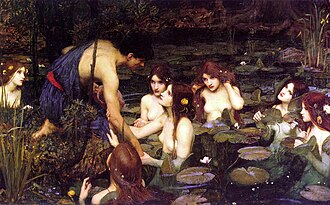 Hylas und die Nymphen - John William Waterhouse (1896)
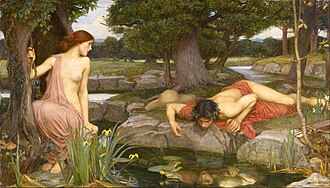 Echo und Narcissus - John William Waterhouse (1903)
.jpg) The Lady of Shalott - John William Waterhouse (1888)
The Lady of Shalott - John William Waterhouse (1888)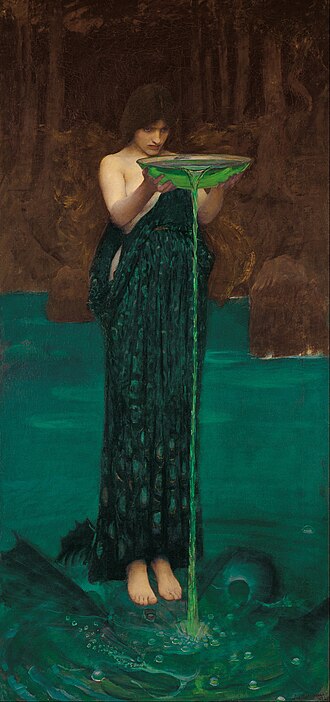 Eifersüchtige Kirke - John William Waterhouse (1892)
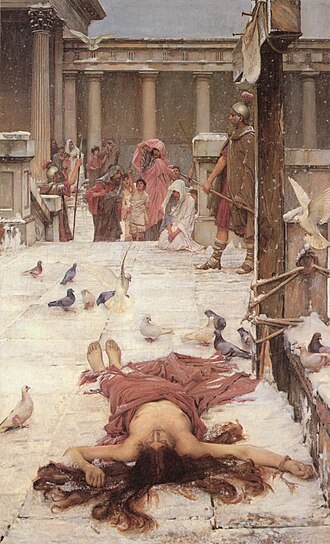 Saint Eulalia - John William Waterhouse (1885)
.jpg) Odysseus und die Sirenen - John William Waterhouse (1891)
Odysseus und die Sirenen - John William Waterhouse (1891)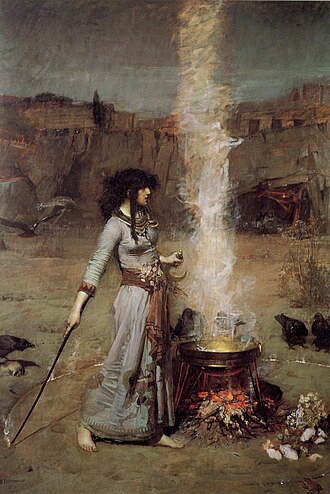 The Magic Circle - John William Waterhouse (1886)
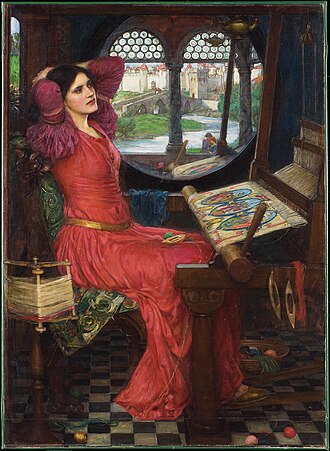 "I am half sick of shadows" said the Lady of Shalott - John William Waterhouse (1916)
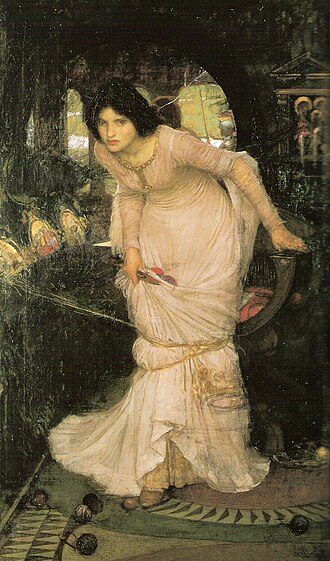 The Lady of Shalott looking at Lancelot - John William Waterhouse (1894)
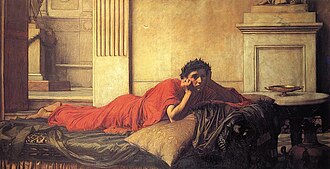 The Remorse of the Emperor Nero after the Murder of his Mother - John William Waterhouse (1878)